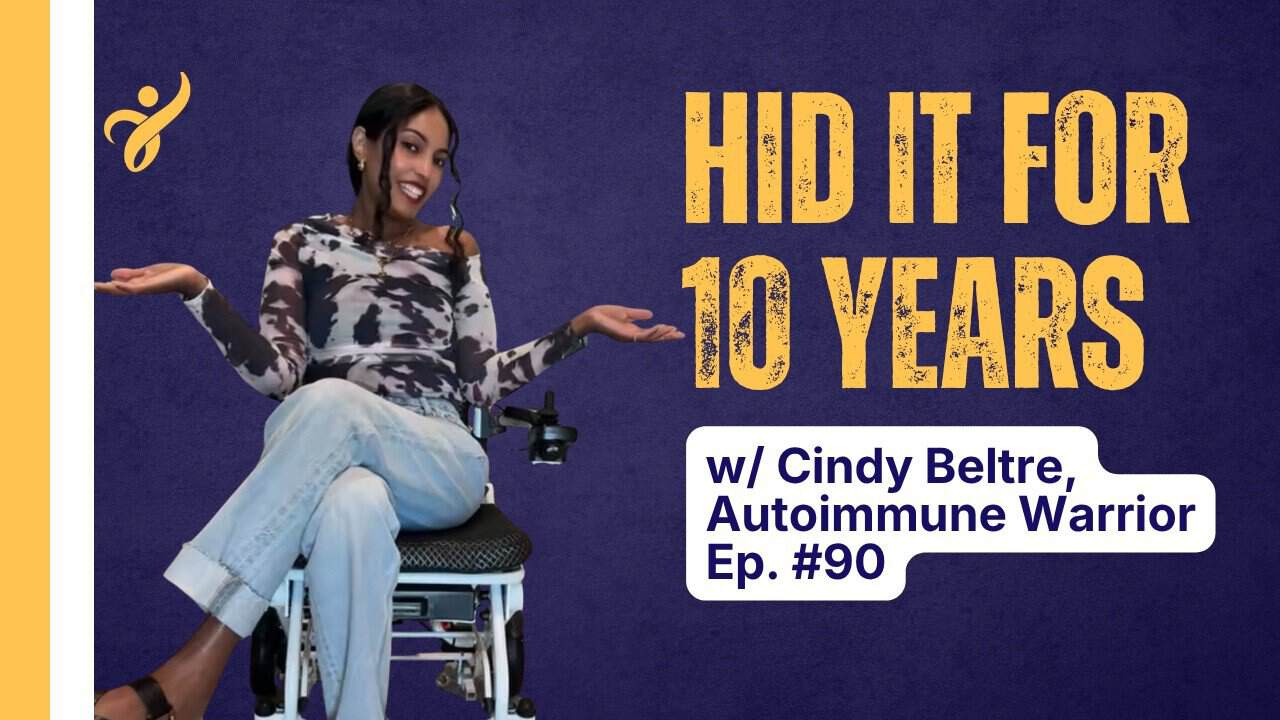
She Hid Her Chronic Illness for 10 Years: Cindy Beltre’s Story
▶ Listen on SpotifyAbout This Episode
Have you ever downplayed your symptoms at work, turned down accommodations, or pushed through so no one would know? Cindy Beltre, a NASA program analyst, hid her autoimmune diagnosis for 10 years. On this episode of Invisible Strength, she joins Karin and Chris to talk about why she hid it, how masking made her sicker instead of stronger, and the changes, from therapy to an electric wheelchair, that helped her build a fuller life.
Key Takeaways
- Cindy carried shame about her diagnosis for a decade and believed hiding it was the only way to reach her goals.
- Hiding it made her sicker and made everything harder. She believes accepting help sooner would have gotten her there faster.
- For years her symptoms were written off as anxiety, including a military discharge that called her healthy.
- A 12-mile hike, where her husband carried her the final mile, was the moment she knew something was wrong.
- Therapy, pacing and assistive devices, like an electric wheelchair, have changed her daily life and her family’s vacations.
A decade of hiding
“I carried a lot of shame and guilt with the condition,” Cindy said. “At the end of the day, I knew it wasn’t my fault, but for some reason I still carried this sense of shame.” She believed the only way to have her dreams come true was to hide it: “If nobody knew and I acted like it wasn’t there, then it wasn’t there. And that wasn’t the case. It made me sicker.”
She went on to build the life she wanted: a child, a family, a house and a career. Looking back, she says it would have happened anyway, and probably more easily, if she’d accepted the help and accommodations she needed. “There’s no shame in it,” she said.
Get the Free RESET Guide
A flexible, judgment-free framework for rebuilding life with autoimmune disease — on bad days and good ones.
Misread as “just anxious”
Cindy was an anxious child and teenager, so she wrote off a lot of early signs. She could never pass the run in high school, even though she was in the gym all the time. She enlisted in the military, went through basic training, and didn’t pass the run there either. She was discharged and told she was healthy and just didn’t want to run.
The hike that changed everything
The turning point came on a 12-mile hike through the redwoods in California with her husband. It kept getting harder, and in the last mile she couldn’t breathe. She told him to go ahead and get help. Instead, “that man lifted me up over his shoulder and carried me the last mile of the hike.” That was the moment she realized something might really be wrong.
Why therapy made the difference
Cindy always followed her medical treatment. “But the help I needed the most was a therapist, and I didn’t go to seek that help until I was at my low,” she said. By then she was depressed, her marriage was struggling, and she was angry at God and at herself. Therapy helped her learn that her health matters and that she has to put herself first. “You can’t pour from an empty cup.”
Pacing, and the wheelchair story
Cindy still overdoes it some days, but she’s made small changes, including buying an electric wheelchair. Using it on a family cruise was eye-opening. “I’m baffled at the fact I’ve never thought to buy something like this,” she said. “Why have I been killing myself on vacation?” Assistive devices aren’t giving up. They can be what lets you actually enjoy the trip.
Advocacy, community and a future nonprofit
Today Cindy builds online community for others with chronic illness and writes about her journey for rarediseases.com, with the goal of helping doctors spot symptoms sooner. She dreams of starting a nonprofit that hosts events designed for people like her, with shade, seating and accessible bathrooms, instead of fundraisers built around running.
Her advice for anyone early in their journey: “Advocate for yourself. If you have a doctor and you feel like that doctor is not listening to you… find another doctor.”
Follow Cindy on Instagram at @sin_der_ellaaaaa.
Notable Quotes
Episode Chapters
- 00:00 — Intro & Meet Cindy
- 00:52 — Life Outside the Diagnosis
- 02:12 — A Decade of Hiding Her Diagnosis
- 04:14 — Hitting Rock Bottom & Starting Therapy
- 05:45 — Misread as “Just Anxious” — the Military Discharge Story
- 07:22 — The Hike That Changed Everything
- 08:10 — Turning Failure Into Fuel
- 09:38 — Why Therapy Made the Difference
- 11:48 — Everyday Mindset Shifts
- 12:45 — Finding a Partner Who Gets It
- 14:42 — Loving Family From a Distance
- 18:27 — Pacing & Assistive Devices (the Wheelchair Story)
- 20:27 — Parenting with a Chronic Illness
- 22:12 — Her Diagnosis Process
- 24:23 — Rebuilding Self-Confidence
- 25:36 — Building an Online Support Community
- 28:26 — Writing, Advocacy & a Future Nonprofit
- 31:30 — What “Invisible Strength” Means
- 32:10 — Where to Find Cindy + Her Advice
Your turn: What condition or challenge do you want to hear about on the show? Leave us a comment on YouTube.
Never Miss a Story
Subscribe to Invisible Strength on YouTube and join our email list for new episodes, free resources and support.
Join Our Email List →Frequently Asked Questions
Why do people hide a chronic illness?
Cindy carried shame about her diagnosis for a decade and believed hiding it was the only way to reach her goals. She says hiding it made her sicker and that accepting help sooner would have gotten her there faster.
Can chronic illness symptoms be dismissed as anxiety?
For years Cindy’s symptoms were written off as anxiety, including a military discharge that called her healthy. A 12-mile hike, where her husband carried her the final mile, was when she knew something was wrong.
What has helped Cindy day to day?
Therapy, pacing and assistive devices, like an electric wheelchair, have changed her daily life and her family’s vacations.
Cindy’s experiences are personal and this FAQ is general information, not medical advice. Talk with your healthcare team about your own care.
Read the full transcript
This transcript was generated from the episode’s captions and lightly edited for readability (filler words removed, names and condition terms corrected). Paragraph breaks mark a change of speaker. It may contain minor errors.
[0:00] Hey, hey, welcome to the Invisible Strength Podcast. Today’s guest describes herself as an autoimmune girly living her full life, but that wasn’t always the case. She has gone through the ringer with several diagnosis, countless medical procedures. She’s really gone through it, but despite all that, she has come out the other side and figured out how to live her fullest best life despite her conditions. And she’s a huge advocate for people with autoimmune conditions. So, I’m excited to welcome Cindy. Thanks for joining us.
[0:35] Hi, thank you for having me.
[0:37] Absolutely. And if you’re new here, I’m your co-host Karin Wagner, a lupus warrior for almost 20 years, and I’m joined by my amazing co-host Chris Bert. And thanks for joining us, Chris.
[0:49] No, always a joy to be here with you, Karin, and excited to chat with you, Cindy.
[0:53] Same here.
[0:54] Cindy, to kick us off, can you just tell us a little bit about yourself outside of your diagnosis?
[1:00] Yeah, so I’m 31 years old. I’m a mom. I’m a wife. I’m a professional. I work as a program analyst at NASA, and I’m just navigating life with a chronic illness, like everybody else, just figuring it out.
[1:12] That’s impressive.
[1:14] Right? Just the casual, you know, at NASA. It’s cool.
[1:20] Just dropped that in there right there. Good for you, though. That’s amazing.
[1:24] Yeah, it’s not something I I debated whether or not I was going to share something like that, cuz I don’t want to scare people knowing where I work, but it’s more so to inspire them and let people know that just because you are dealing with a chronic illness and something that you feel like is going to prevent you from becoming a professional and building a career and all those things. It’s not true. It’s all in your head, and yeah, it might take you a little bit longer, but that it’s possible. Anything’s possible.
[1:50] Sure. What I love about that it is because people, especially when you’re in the thick of it with your illness and maybe you had to take time off from work or spend a while since you’ve been in work. I think you lifting that up, it just reminds me of that phrase where people say, you can’t be what you can’t see. So, you mentioning it, even though I understand the hesitation around it, it still gives people a sense of like, “Wow, it is possible.” And so, I thank you for sharing that, for real.
[2:14] Yeah, no, of course. Cindy, you have several diagnoses, but outside of that, how did you go from being successful, all of a sudden you have all these conditions popping up, to then deciding that you needed to be a great advocate for people with autoimmune conditions?
[2:33] So, it wasn’t always the case. unfortunately, it took me 10 years of my life to get to that point. I carried a lot of shame and guilt with the condition for whatever reason, because like, at the end of the day, I knew it wasn’t my fault, but for some reason, I still carried this sense of shame around it and thinking that I wasn’t enough or comparing myself to other people when I shouldn’t have. And I thought that the only way I could get ahead in life and have all my dreams come true was if I hid it, if I just if nobody knew and I acted like it wasn’t there, then it wasn’t there.
And that wasn’t the case. It made me sicker. It made things harder in life for me when it shouldn’t have been and I did. I had to work 10 times harder to get where I am today because of it versus if I would have accepted my condition, accepted that I did need help or that I did need accommodations, maybe I would have gotten her faster versus failing classes because I was missing so many days because I was being hospitalized and not wanting to ask my professor for extensions because of my pride, because I shouldn’t need that.
[3:37] I shouldn’t need another day to take an exam. I shouldn’t need more time because I want to be like everyone else.
[3:43] Right.
[3:44] But pushing through all of that and then doing the big things like having the kid, having the family, buying the house, having the career, once I did all of that, it was like I was able to do it and I I don’t know why I felt like I needed to hide a huge part of my life to get there. Like it would have happened regardless and it probably would have been easier if I just accepted who I was at the time. So I just want to bring awareness to that like there’s no shame in it. Just accept who you are and then, you know, get past it, navigate it and keep going.
[4:15] No doubt about it. What was that moment for you where in spite of the pride in spite of all the ways you just wanted to be like everyone else? Where you just couldn’t deny it anymore. You needed to acknowledge what you were facing.
[4:29] Well, I had a lot of those moments, but I think it’s it was more so when I fell into a really hard like depression because of it all. Just a lot was going wrong in my life and then the illness and then I was being hospitalized constantly and then failing a semester because of it and then my son was a toddler at the time and I felt like I was failing as a mom, too, cuz I needed so much help from my husband to help me with them.
I think that might have been the awakening where it’s like, all right, you need to see a therapist and talk about this and figure out why you feel this way about yourself. Cuz it’s not like I was a bad person or something wrong with me internally. I was a good person. It’s just I still just didn’t feel like I was enough.
[5:11] Yeah. That sense of failure is so real, especially when you’re in the thick of it and you’re not managing your condition well because you’re trying to do all the things. I know I’ve for sure been there.
[5:26] The other piece that you bring up that’s super important is the mental health aspect of it and recognizing that you do need to go to therapy and that can make all the difference in how you view yourself as a person with these conditions and help you separate your self-worth from your accomplishments.
[5:45] Yeah, 1,000%.
[5:47] Cindy, can you take us back to when you first started maybe not noticing symptoms, but you were experiencing panic attacks and anxiety and unfortunately in this community a lot for women, there’s the stigma of yep, we’re just chalking it up to anxiety. Was there point or when was the point when you’re like no, there’s something more serious going on here?
[6:12] Right. So, I was an anxious child and anxious teenager. So, I always wrote it off as that’s just who I was and I overlooked a lot of things from my childhood like simple things like not passing the run in high school. I was never able to pass the run. Just wrote it off as I’m not fit. Even though I was you know in the gym all the time and trying.
[6:32] Right.
[6:34] And then I even enlisted in the military. Went through basic training. Didn’t pass the run ironically.
[6:41] And they held me for an extra couple months. And pushed me harder. Made me run more than everybody else, work out more than everybody else. I started becoming swollen, heavier.
[6:52] Wow.
[6:53] The run my run time was getting worse. And then eventually they just discharged me. Because they were like you’re healthy, you just want to do this. There’s no reason for you to not be able to pass this run. And that was a really hard I don’t think I ever felt more of what a failure than at that time. Cuz at that time I didn’t know.
[7:08] Yeah.
[7:08] I just and they’re telling me you should be able to do this. They’re yelling in my face. You should be able to. There’s no reason you can’t do this. So, after that I got out and re-evaluated my life, decided to go back to school and I was like, well, that didn’t work out. So, on to the next thing.
[7:23] Right.
[7:25] And then got married. Me and my husband were on a hike through the redwoods in California. And it was a 12-mile hike and it was getting increasingly harder. The more time we spent and then once we got to the last mile I just couldn’t breathe anymore. I just stopped. and down and I told him like listen now you’re going to have to just make it to the end and get help and come back for me because there’s no way I can keep going. And I that was me like holding on like I don’t think I like you got to go.
And it was getting dark so it was scary and then by the grace of God that man lifted me up over his shoulder and carried me the last mile of the hike. And we made it out just fine so but that was the the moment I was like I there might be something wrong with me.
[8:10] Yeah. Yeah. I know that had to be scary for y’all and I just think about you know we’ve been talking about that sense of like feeling like a failure and all like the challenges that you’ve gone through. What now would you say has given you the confidence or been like a source of like good pride in your life? Like have you been able to silence that voice that made you feel like a failure? Like how does it live with you still?
[8:37] I have and it’s only because every time I failed like basic training, failing that, that was a harsh failure. But the fact that I got up and then I still said you know what no reroute we’re going to go to school. It’s fine. That didn’t work out next plan. When I did that and I was hospitalized and failing semesters I was still in the hospital with my books studying trying and asking if they could let me go discharge me so I could go take my test and I would come back I promise.
It was things like that like even though all the odds were against you and everything was saying just give up just trying over and then once I it wasn’t until I reached all my accomplishments even though it took me longer like it took me like six seven years to get a bachelor’s. It shouldn’t take that long it shouldn’t take that long.
[9:20] But because of everything I went through it did take me that long. And it wasn’t until I accomplished it and did it all that I was like you’re not a failure. You’re going through something that most people never have to experience and you’re still accomplishing more than average person. Come on. That’s so real. That’s so real. Very amazing. During all those challenging times and you hadn’t received a diagnosis yet. You had said denial was your path forward. So, how long did you just write off your symptoms before you sought to get help?
[9:52] So, I always got the help like medically like I always got my medication. Whatever they told me to do, I did. But, the help I needed the most was a therapist and I didn’t go to seek that help until I was at my low. At the bottom of the bottom where I was depressed, my marriage was in shambles, my kid needed speech therapy, I could tell like I was failing him as a mom. It was just overall my life was falling apart.
[10:20] And that’s when I was like, either I get therapy and I figure out what’s wrong with me because I was angry, too. On top of all that, I was just angry. I was angry with God, angry with myself, and that was when I woke up and I was like, I need to talk to somebody. If I didn’t feel comfortable enough speaking to those around me, I need to talk to a stranger. That was it.
[10:38] Yeah. Now, that’s such a tremendous step because a lot of times people who are living with chronic illnesses don’t either understand or are willing to accept the fact that we’ve been traumatized, that what you’ve gone through is severely difficult and just jams up the whole system. Talk to us a bit about the way in which addressing your mental health has helped you just deal with like the everyday.
[11:01] I think addressing that has helped me navigate anytime I do have a major event again in my life. So, I take it back to everything that my therapist taught me how to work through my triggers and how to learn when something is starting to give me anxiety or just becoming overwhelming or too much, learning to take a step back and realizing that and acknowledging I can’t help everybody. So, if somebody is asking me for help and I’m already overwhelmed, I need to be able to say, “Listen, I can’t help you today. I can’t.” I Learning to put myself first. I’m learning that my health does matter.
That I I have to put myself first if I want to be able to help anybody around me. You can’t pour from a an empty cup.
[11:47] Certainly you cannot.
[11:48] I was a big issue.
[11:50] Yeah. Absolutely.
[11:51] It’s so critical, but also a really hard thing to implement in everyday life. From that, what are some of the other mindset shifts that have helped you cope with your diagnoses and unexpected symptoms popping up along the way?
[12:09] A mindset of just taking it a day at a time. There’s days that it can be a lot and it’s okay to lay in your bed and cry about it. Just don’t stay there. Like just always try to get yourself out of that. Give yourself the grace to be upset about it and to feel all the feels because you deserve to feel all those feelings. They’re they’re valid. But don’t dwell in them. Don’t sit in them. Don’t mourn, “This is my life.” because there’s more to life than your illness. You can make something out of it and your life can still be great regardless of your limitations.
You just have to learn how to navigate those limitations.
[12:44] That’s really it. That’s really it. When you think about how you’re trying to live your life now, what sort of strategies do you use to deal with taking on a challenge? I’m not necessarily talking about the challenges of a chronic illness, but necessarily thinking about moving up like in with ambitions or like the challenges that comes from being a parent or being a spouse. Like, what’s your mindset now? Like, how are you handling that while making sure that you’re also taking care of yourself?
[13:14] I’m fortunate that I have an incredible spouse. He’s very understanding. He’s seen me in very difficult situations and seen me hospitalized. So, he’s a big advocate of like, “Leave me alone. If you see that she’s out of breath or she needs a second we’re stopping, we’re all taking a break.
[13:29] Yeah, yeah.
[13:29] Because my wife comes first, so ultimately finding a spouse that genuinely cares about your well-being
[13:36] Is huge if you have a chronic illness.
[13:39] Yeah.
[13:39] You can’t just marry anybody. You’re Who you choose to marry really matters.
[13:43] And like when they say in sickness and in health and all of that those vows, those vows, man, that they come into play.
[13:50] Yes, yes. And I love that you lift that up because I remember saying to my wife, and I’m sure a lot of us who are who are partnered and we said those vows, but didn’t necessarily expect to like cash them in so early, you know? Like I know what I was talking about. I was like, “Yeah, well, we’re a hundred, right?” Like in sickness and in health, but not when you’re in your 20s or 30s. But yeah, definitely marrying someone who has that compassion is critical.
[14:14] Oh, yeah, for sure. And then like that also even came with a sense of guilt like after the fact like am I trapping him into this lifestyle? Like could he do with somebody else? Like he deserves somebody else because of it. And you know, he helped me along the way a lot with that. Like he’s letting me know like, “No, regardless of the fact, I love you and I want I would be with you whether you had this or not.” So, I’m blessed in that aspect. Not many I know there’s plenty of people that aren’t as lucky. So, that’s by the grace of God.
[14:42] Yeah, no doubt. No doubt.
[14:44] Right. To your point, it does make all the difference to have a supportive spouse and network around you. So, with that said, have you changed how you communicate with your spouse and or the people in your broader support network? You had mentioned that for a while you hid what was going on, and now you’re a big advocate. So, what is that communication for you look like, and how has that evolved over your journey?
[15:15] I had to be very honest, and it’s hard because you don’t want people to look at you with eyes of sympathy. And you I feel like everybody feels bad for you. And it’s like, “Oh, we can’t ask Cindy for help. She’s sick.” Or we can’t invite Cindy because that would be too much for her. And it’s like I it comes with a isolation in its own and they don’t mean to be that way. So, it’s like after you explain your diagnosis to them and explain everything that’s going on with you, that’ll happen and you’ll learn the people that really care about you and you’ll lose some friends, you’ll lose some family.
And you might even have to separate yourself. For example, I used to live in New York and that’s when I was the sickest I’ve ever been.
[15:58] And granted, I love my family. I love them, but it comes with a different level of stress of they’re depending on me or they’re going to call me and ask me, “Hey, can you pick up the kids? Can you do this? Can you do that?” And it’s hard to say no cuz you’re family.
[16:11] [clears throat]
[16:11] We ended up moving out of state because it was becoming too much and I came to that realization and my husband was like, “Listen, either we move and create some space and see them when we can and when you’re feeling up to it or you’re going to kill yourself trying to accommodate all these things.”
[16:26] That is so real and even you know, as you were saying that, I’m a New Yorker and just thinking about just the pace here is just so stressful. And when I moved to the South for a few years, I was like, “Oh, this is like not everybody live this way.”
[16:42] Yeah, I know. That’s what I was thinking. When I moved here, I was like and then we’d talk about deadlines and the deadline would come and nobody was ready. They’re like, “All right, we’ll push the meeting to next week.” Like it was nothing.
[16:51] Yeah, like it’s not a thing, right?
[16:53] That would never fly in New York. Are you kidding me?
[16:56] Never.
[16:57] Cindy, bringing that up, Chris, it reminds me of the time when you said sometimes you have to love them from a distance.
[17:04] But it’s so true. It’s so true. Because not everyone’s going to get it and not everyone’s going I mean, people can conceptually understand it, but in their bones and in their rhythms of how they treat you, you can tell they don’t get it yet. And that’s not something we can afford to wait for them to catch up on the lesson cuz they might learn it after you gone and be like, “I finally get it now.” But it’s too late for us. So, we have to love some folks from a distance cuz otherwise it’s too exhausting and we can’t deal with that level of stress.
[17:36] And the biggest issue is that we don’t look sick.
[17:39] That’s it.
[17:39] So, they don’t get it because they’ll see us one day and not them knowing like all the medications, all the prednisone that I had to take, that I had to sit on oxygen for an hour before I went to this event.
[17:50] Come on.
[17:51] And I’m partying as hard as I can with you and you know, trying and pushing myself. Now I get right after I get home. How good I am, how stuck I am in bed for 3 days because I gave it all I had to be with you, have a good time with you. So, then they only see that little part that you look fine and you’re doing great and assume that you’re faking it, that you’re just she’s fine.
[18:13] Yeah, that’s it. That’s it. Now, people don’t understand spoon theory and just understanding that you know, in order for you to hang out and vibe, you have to borrow from you know, Saturday, Sunday, and Monday, you know what I mean? You won’t be back for the whole week, for the whole week. That is it.
[18:29] But hearing you both talk about pacing and that’s something that it’s still a work in progress for me. A question for both of you is how have you adjusted so that you are going at a pace that’s not overdoing it?
[18:45] I mean, there’s some days I still overdo it and I feel it the next day and I’m like you keep trying to keep up with these able-bodied people, you’re going to end up in chest stiffness.
[18:54] Come on.
[18:55] But no, I so I’ve made little transitions in my life like I bought an electric wheelchair. So, this is my first time using an electric wheelchair on vacation. We were on a cruise and I’m like baffled at the fact I’ve never thought to buy something like this.
[19:11] Right.
[19:11] So, why have I been killing myself on vacation? Cuz those places are huge. And you’re walking back and forth all day
[19:16] Everywhere.
[19:17] Just to go eat or go to the pool or to go anywhere. It’s exhausting. By day two, you’re like, “Oh, I’m going to spend the rest of vacation in the room laying down.”
[19:25] And this was not the case this time. I was out the entire time. I came back and I was ready to go to work the next day. I was fine. So, using your assistive devices, I I know they’re embarrassing at first and it’s really hard to get past that, especially when you get up from a wheelchair and they see you walking and it’s like, “Why is that girl sitting in that?”
[19:44] Right, right, right.
[19:45] But it’s like just brushing all those looks off and that was probably the hardest part. But after that, you’re like, and you feel great. You’re like, “Well, this is worth it. Should have used this a long time ago.”
[19:54] No doubt. No doubt. You know, Cindy, what you’re saying makes me just think about the commitment we have to ourselves in terms of like the kindness we demonstrate toward ourselves because a lot of us are kind to other people, but not necessarily kind to ourselves. And it’s not even just like, you know, we talked about pride earlier, but it’s really just like, are you cuz you would not allow anyone you cared about to struggle in the way that you allow yourself to struggle. You know what I mean? And so like, we have to have that commitment to say like, I’m going to get the wheelchair.
I’m going to use the assistive device and all these things. Is there any, you know, when you think about like with being a parent, have you been able to like pace yourself with regard to like that aspect of a family?
[20:39] Has that been like a part where not that you solved it, but something that you’ve also been able to sort of figure out as a mom?
[20:46] Yeah, so even like that for our Disney trips now.
[20:50] Yeah.
[20:50] I’m bringing that wheelchair.
[20:51] -huh.
[20:52] It’s coming because that’s the only way I can still enjoy my son and give him a childhood and do all those things.
[20:58] Yeah, yeah.
[20:59] And he knows that it’s heartbreaking sometimes when he’s like, “Mom, come push Harper with me.” And it’s like, “Baby, I really can’t.”
[21:06] Right.
[21:07] And you know, I do my best. I’ll try to find a substitute or if his dad’s not there, I’ll ask one of my friends to come along with us to the park or just working days where he’s still having a childhood, whether or not it’s necessarily that I’m the one doing it with him.
[21:21] Word.
[21:21] Like and that part, you know, it’ll always break your heart cuz it’s like you want that memory to be with you.
[21:25] Of course.
[21:26] But as long as they’re still having those moments, I think they’ll still grow up to be solid individuals.
[21:32] 100%. 100%.
[21:35] I once had a therapist tell me that you’re going to raise more empathetic children cuz they’re going to see the struggles and challenges that you go through, but you’re still showing up every day.
[21:46] And he’s told me that before and I think the hardest part is like when I am sick and he sees it and he just goes, “Mom, I wish you didn’t have an illness. I wish this would just go away for you. I hate seeing you like this.”
[21:59] Yeah.
[21:59] Like those moments are like the hardest moments. Other than that,
[22:03] Push through. You push through.
[22:06] Yeah, those are tough moments. I would say for sure.
[22:08] Damn that.
[22:08] It’s watching your kids heartbreak for you.
[22:11] Most definitely. Now, as we’re chatting, I’m realizing that there may be some folks in the audience who have heard you talk about some of the symptoms, but may not precisely know the ways in which your chronic illnesses have affected you. So, could you talk to us a bit about the diagnosis process? Like was that something that took a long time once you were able to say to yourself like this is a real thing I need to get checked out? Like did you have a long waiting period to get diagnosed?
[22:44] I would say all in all, it was probably like four or five months.
[22:48] Okay.
[22:48] But it was easier for me than most because I was in an active flare-up. So, when you’re in an active flare-up, the blood work’s coming up, the all the signs are showing. It’s easier cuz see it in the test. But if you’re not in an active flare-up, it going to take you It could take you years to get diagnosed.
[23:05] Yeah.
[23:06] You have to go You have to be lucky enough to be at that doctor’s office at the right time. And I just happened to be hospitalized at the right time where they kept me for a month and ran as many tests as they could. And what really I think got it for them was the lung biopsy. So, once they saw that I didn’t have cancer, but I had all the scarring in my lungs,
[23:25] Right.
[23:26] That’s when they did all the right tests to figure out like what’s causing the scarring. And then it’s like, “Oh, it’s not an immune disease.”
[23:31] I see. Yeah, I’m curious if you had the similar reaction that, you know, I’ve had and and other guests in the past have expressed of like almost a sense of relief of knowing exactly what it was. Like, what sort of clarity did you get from knowing it was what was diagnosed?
[23:52] So, I think it was like, “Wow, you’re not crazy.” Like, right? This whole time people have just been writing you off as lazy. Yeah, she just doesn’t want to do it or And it’s like I don’t even have that to discuss. You know? And it’s like it hurt to see that things people just assumed I was being lazy. And it’s like if you really knew me, you would know that wouldn’t be the case. And if anything, if you really knew me, you should have said, “You should probably go to a doctor, girl, cuz that’s weird.”
[24:16] Yeah.
[24:17] So, that I think that was that was probably it for me.
[24:21] Having people second-guess you and your character, I’m curious how you built back up your self-confidence after dealing with such tough moments with other people.
[24:34] Yeah, that was I got to give it to that therapist, man. She really She saved my life in a lot of ways. And I’m forever grateful for her. Because, you know, it takes a special person to listen and hear you and understand you. And like explain to you like that you’re worth so much more. And like, who cares what these people think about you? You know, if they really cared about you and they knew you really were, they wouldn’t say those things to you. Knowing that’s going to hurt you.
[25:06] I appreciate that cuz it really allows you to separate yourself from other people’s opinions, which just are not needed.
[25:14] No, they’re not. And I don’t know, it’s a really tough journey, and it’s like with this illness, you lose yourself so many times and find yourself and lose yourself. So, it’s like every time you get a new symptom or a new diagnosis or whatever, you lose yourself all over again. And it’s like a restart all over to figure out who you are now with this.
[25:36] Absolutely. Have you been able to form a sense of community? And not just talking about your loved ones, but in terms of folks who have gone through this in some degree or another. Like, how has that sense of knowing that you’re not the only person who’s going through this been for you?
[25:53] It’s actually helpful. That was a major reason why I started my platform because I wanted to talk to more people like me.
[25:59] Yeah.
[26:00] I wanted to have friends that like really understood, not just, “Oh yeah, I got it.” Like, you’re going to stay home today. You can’t go out. No, like these girls know, like she’s in a flare-up. Maybe I should send her some soup or something, you know? Like, maybe I You know, just cuz they’re going to be a little more considerate because they get it.
[26:16] Right.
[26:17] So, I actually have a channel on my Instagram now with like 60-something people.
[26:21] That’s cool.
[26:22] It only allows cuz Instagram is weird, they only allow a certain amount of people to chat in the channel. So, I think it’s only like 20 of us that can actually type. But still, like over the last couple months, we’ll let each other know, like, “Oh man, it’s been rough this week. I was hospitalized.” “Anybody ever had a hysterectomy? Has anybody gone through this?” And we’re sitting here guiding each other even with like health insurance things and how to get on disability and all these things and how to get accommodations at work. And it’s huge. It’s huge because I get it.
So, they can they are helping you.
[26:52] Absolutely. That’s beautiful.
[26:55] It comes up often that like even if you have the best spouse support network, having that community who’s gone through it or been through similar things can make all the difference in feeling validated, understood, and helping each other navigate it because there’s so many random things that pop up along the way.
[27:16] Oh, yeah. And the sense of humor is different, too. It’s well, our sick first I don’t know what it is, if you’re talking to an able-bodied person who makes I don’t know, a joke about your illness or a joke about your condition, it’s awkward.
[27:30] Yeah.
[27:31] And versus somebody who’s going through it, they’re going to laugh with you and probably make an even funnier joke that’s even darker than what you said.
[27:37] For real.
[27:37] But you get it because it’s true. It’s like not funny, but it’s funny.
[27:41] Yeah, we are privileged to enjoy gallows humor on this side. We get a chance to try to make light of something that’s really serious. And you saying that Cindy reminded me of being in the hospital and trying to crack jokes, but no one was in a laughing mood cuz of how seriously my flare was going. I was just like, “Y’all, I need you to laugh with me. Don’t look at
[28:01] Yeah, like what
[28:02] Your face is telling me how bad I look.”
[28:05] Right, it’s like, “Are we going to laugh or cry about this?”
[28:07] Yeah, we got two choices, right?
[28:09] Well, and sometimes that’s the best way to get through those really dark times because there’s a wave that comes over you that’s like, “I cannot believe this is happening and this is my life right now.” So, the best way through it is let’s just have fun with it and that’ll help us get through.
[28:26] Oh, yeah. No, for sure. So, I’m curious, in addition to community, have there been other silver linings that have come out [clears throat] of your journey?
[28:34] Yeah, so actually I got an opportunity to write for rarediseases.com. So, yeah, they’ve been letting me talk about my journey and it’s supposed to help healthcare providers, doctors, or and other people with the condition or family members of people with the condition, read and understand what people are going through, and hopefully help doctors like spot symptoms that they could have noted before to diagnose a person faster. So, I think that’s been an amazing opportunity that this platform has given me.
But, long-term, I’m hoping that if I continue to grow the platform to a point that it’s large enough to possibly start a non-profit, and put that money towards research and to be able to get a diagnosis faster, as well as to help people get these assistive devices like electric wheelchairs, because one insurance doesn’t cover them, and they’re expensive. And it’s mostly these people are living on disability.
[29:26] So, let’s be for real, how are they going to cough up 1,500 when it’s like they can barely pay their rent? So, that’s the long-term goal of it all. But, even then, even if that doesn’t come from it, at least I built a community for myself. So,
[29:41] Well, and for others, it sounds through the conversations that you’re having, that you’re already making a big impact.
[29:48] Right. Yeah, to help anybody feel seen, I think that’s amazing, as well.
[29:52] It makes the world of difference, Cindy, because so many people, and I remember being reminded of this when I was a part of a support group, it’s just there are so many folks who never get a chance to speak about this and have empathy returned. Like, so many of us just have to settle for sympathy, have to settle for people feeling sorry for you, but never getting that sense of I understand, and for you to create a community where people can get that sense of it. I mean, I won’t mince words, like it’s life-saving work, you know, to give people that sense of being understood.
[30:28] I would love to create events that are for us, you know? Because all the fundraisers and everything that exist are like run for lupus, or run for pulmonary fibrosis, and it’s like I can’t run.
[30:40] Right.
[30:40] So, off the bat, you’re telling me I go to an event that’s essentially created for me.
[30:45] Yeah.
[30:45] Right? So, the events I want to create are, you know, there’s music, there’s food trucks, there’s shaded area for people with lupus that can sit. They don’t have to be as exposed to the sun. There’s wheelchair accessible bathrooms. Like, it’s just inclusive of us all versus having my family, like asking them, “Hey, can you run for this fundraiser for my lungs?” Like
[31:07] Right.
[31:07] I would like to be included in those things.
[31:10] So real. That’s so real. I love that cuz it is just a matter of creating access and by creating those access points, you’re also upholding people’s dignity, you know? Yeah.
[31:21] We have talked about how a lot of times you look perfectly fine. These are invisible illnesses and people don’t see all the things that go on behind the scenes just for us to show up on a day-to-day basis. So, with that, I’m curious, what does invisible strength mean to you?
[31:39] That’s a good question. Invisible strength for me is probably knowing and accepting that I have limitations, but not letting those limitations define me or the life that I want to live.
[31:49] Love that. Especially when we’re going through such hard times, it can be hard to envision a future that you can have a full life, you can accomplish whatever goals you want to go after. It’s just about adapting and pivoting and finding a different way of doing it or maybe taking a little bit longer to do it and that’s perfectly okay.
[32:11] Oh, yeah, I agree.
[32:12] So, Cindy, how can we support you, find you online, keep up with all the incredible work that you’re doing?
[32:19] Yeah, so my main page is on Instagram. It’s the Cinderella It’s @ and then it’s like s i n _ c e r _ ella.
[32:28] -huh.
[32:28] So, I don’t know if you can ping it up here somewhere when you post this.
[32:32] That’s right. That’s right.
[32:32] But yeah, my Instagram is probably the best point of contact for my platform for me and for everything I’m doing. That’s where I get the most updates posted of the articles that I’m writing and the work that I’m doing and hopefully the nonprofit that I’ll create one day will be up there. So, keep an eye out for it.
[32:51] For sure.
[32:52] We’ll drop that in the description. Cindy, with you being such an inspiration, what words of encouragement or advice would you give to someone who’s either early on in their journey or just going through a really tough time?
[33:06] Advocate for yourself. If you have a doctor and you feel like that doctor is not listening to you or isn’t giving you what you need or brushing you off, find another doctor.
[33:16] And if that one doesn’t work, find another doctor. Get a second, third, fourth opinion. Do not give up on yourself. You’re not crazy. If you feel like your body’s off, nine out of 10 chance times, you something’s wrong. So, advocate for yourself, believe in yourself, get the help you need. Yeah, keep pushing, keep striving, keep reaching to live a full life because you deserve to live a full life like anybody else.
[33:40] Love that. Absolutely. Cindy, you’re a remarkable person and truly an inspiration. Thanks for joining us and being so open about your story today.
[33:52] Yeah, thank you so much and I appreciate your time and having me on here and I’m wishing you both best of luck on your journeys.
[33:59] All right. Thank you, Cindy.
[34:01] And thank you for being here, Chris.
[34:04] Always enjoy. Thank you. Thank you so much.
[34:06] To our community, make sure you check out invigorateyourjourney.com. We have coaching to help you process all the challenges that come with these conditions as well as a whole host of other resources to support you along the way. We will see you next Wednesday on the Invisible Strength Podcast. Take care. Peace.
[34:25] Peace out.
[34:26] Peace you. Thank you.
Medical disclaimer: This post is for education and shared experiences only and is not medical advice. Always consult your healthcare team before making changes.

