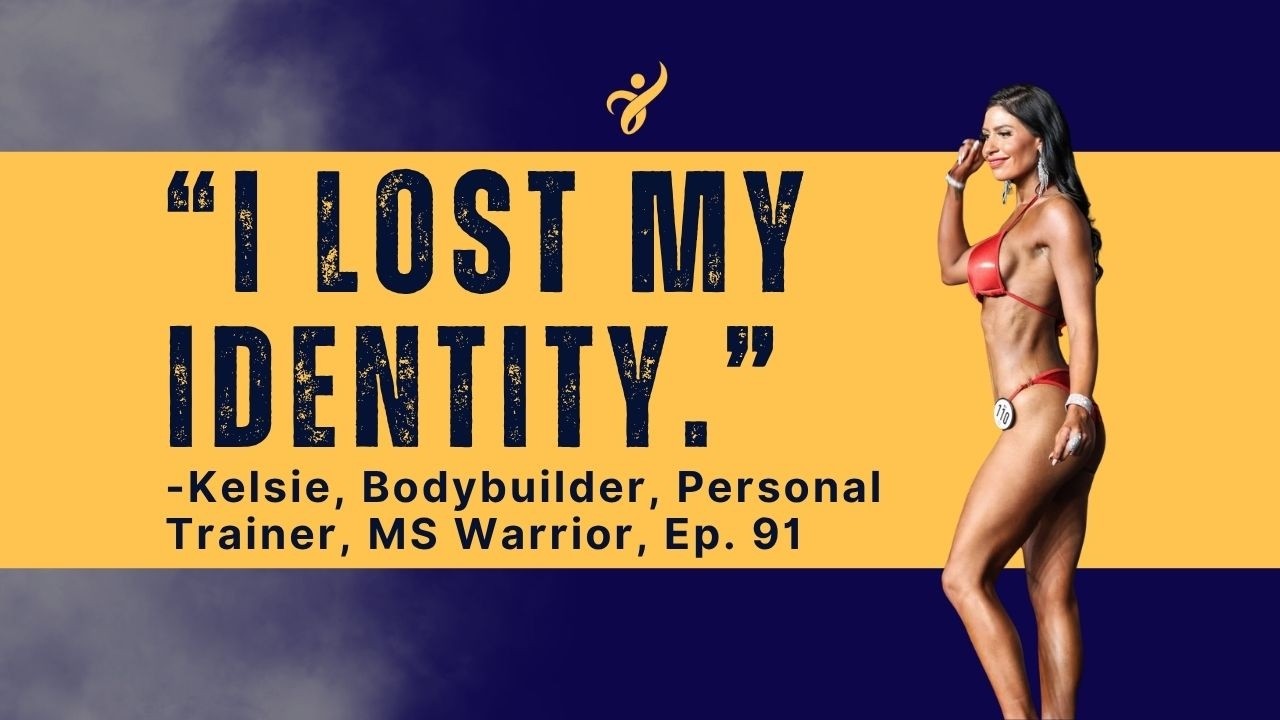
Bodybuilder Diagnosed With MS Mid-Prep: Kelsie’s Story
▶ Listen on SpotifyAbout This Episode
What happens when the body you’ve trained for years suddenly stops cooperating? Kelsie was a competitive bodybuilder, personal trainer and single mom, deep in prep for what she called her “redemption show,” when strange symptoms started. She thought it might be an electrolyte imbalance. The hospital visit ended in a multiple sclerosis diagnosis. On this episode of Invisible Strength, Kelsie joins Karin and Chris to talk about losing and rebuilding her identity, the voice that calls rest “lazy,” and why “slow cooking” her goals beat giving up.
Key Takeaways
- Kelsie ignored early symptoms because of an all-or-nothing mindset and a show that meant everything to her.
- At the hospital, doctors initially prepared her for the possibility of brain cancer before she was diagnosed with MS.
- Her diagnosis made her realize how much of her identity was tied to bodybuilding.
- She hasn’t given up her goals. She’s “slow cooking” them, with a redemption prep still in the works.
- She’s learning to answer the voice that says rest is lazy: “You’re listening to what your body needs.”
Pushing through for the redemption show
Kelsie had an all-or-nothing approach. She was prepping for a show that mattered deeply to her, because the season before hadn’t gone the way she wanted. When symptoms showed up, she ignored them. “I said, ‘Body, you’re not allowed to be doing this, so let’s just keep pushing on,’” she remembered. “Honestly, if it weren’t for my son, I would have kept going.”
The hospital visit and diagnosis
The days in the hospital were some of the hardest. “Initially, they were preparing me for brain cancer,” Kelsie said. The diagnosis turned out to be MS, and in that moment she knew prep was over, at least for now.
Get the Free RESET Guide
A flexible, judgment-free framework for rebuilding life with autoimmune disease — on bad days and good ones.
“Who am I anymore?”
Bodybuilding is a 24/7 job, and Kelsie had built her whole sense of self around it. “It made me realize, wow, I almost lost my entire identity,” she said. “I just saw myself as a bodybuilder, and in the blink of an eye, I lost it. I had this intense grief, because I was like, who am I anymore?”
Karin and Chris point out how common this is in our community. A diagnosis can take away the identity you built before you’ve had time to imagine a new one.
Training with MS: slow cooking the goal
Kelsie didn’t walk away from fitness. She changed the timeline. “I don’t want to say that I put it on the back burner, because it’s not on the back burner, but let’s just say we’re slow cooking now,” she said. As a single mom, she’s restarted her fitness journey many times before. “There’s many ways to get to the finish line.” Her redemption prep and show are still coming, and she’s embraced the longer road.
The “lazy” voice on rest days
For someone used to pushing, slowing down is the hardest part. “There’s this voice in my head that is telling me that I’m being lazy,” Kelsie said. She’s practicing a new answer: “No, you’re not lazy. You’re listening to what your body needs.” Rest days now look like lying down for a bit and baking with her son instead of chasing 10,000 steps.
Grief and acceptance aren’t opposites
Kelsie also coaches clients through their own setbacks, and she talks about holding grief and acceptance at the same time. You can accept your diagnosis and still grieve the life you planned. Both can be true.
Follow Kelsie on Instagram at @kelsielonsocoaching.
Notable Quotes
Episode Chapters
- 00:00 — Intro
- 00:54 — Kelsie’s fitness background
- 01:54 — From coach to patient
- 03:25 — When symptoms first started
- 06:19 — Pushing through for her “redemption show”
- 07:18 — The hospital visit and diagnosis
- 09:19 — Hard days and finding purpose
- 12:23 — Losing her identity as a bodybuilder
- 13:27 — Training with MS: “slow cooking” the goal
- 15:30 — Advice for someone newly diagnosed
- 16:50 — Coaching clients through setbacks
- 18:21 — Life beyond fitness and motherhood
- 19:34 — Rest days and the “lazy” voice
- 21:14 — Grief and acceptance
- 24:14 — What “invisible strength” means to her
- 24:52 — What’s next: the redemption prep
- 26:45 — Closing
Free resource: Grab the free RESET Guide mentioned in this episode: https://invigorateyourjourney.com/reset-workbook/
Never Miss a Story
Subscribe to Invisible Strength on YouTube and join our email list for new episodes, free resources and support.
Join Our Email List →Frequently Asked Questions
What were Kelsie’s first signs of MS?
She ignored early symptoms because of an all-or-nothing mindset and a bodybuilding show that meant everything to her. At the hospital, doctors first prepared her for the possibility of brain cancer before she was diagnosed with MS.
Can you keep bodybuilding with multiple sclerosis?
Kelsie hasn’t given up her goals. She’s “slow cooking” them, with a redemption prep still in the works, and is learning that rest means listening to what her body needs.
What is multiple sclerosis?
Multiple sclerosis (MS) is a chronic disease in which the immune system attacks the protective covering of nerves in the brain and spinal cord. Symptoms vary widely and can include fatigue, numbness, vision changes and trouble walking.
Kelsie’s experiences are personal and this FAQ is general information, not medical advice. Talk with your healthcare team about your own care.
Read the full transcript
This transcript was generated from the episode’s captions and lightly edited for readability (filler words removed, names and condition terms corrected). Paragraph breaks mark a change of speaker. It may contain minor errors.
[0:00] Hey, thanks for joining us on the Invisible Strength Podcast. Every week, Chris and I have the privilege to talk to all sorts of autoimmune and chronic illness warriors who are not only navigating their conditions, but they’re going after their goals, dreams, and accomplishing incredible things. Today’s guest I’m particularly intrigued by because she has taken her fitness journey to a whole another level as a competitive bodybuilder, a personal trainer and having spent more than 10 years in the fitness industry.
Today we’ll talk about Kelsie’s story and how she is navigating her condition while maintaining her fitness journey. Kelsie, we’re excited to have you. Welcome to the show.
[0:45] Thank you.
[0:46] We’re glad to have you. Chris, we’re also very glad to have you. Thanks for making the time.
[0:51] No, always a joy to be on the show. Can’t wait to talk with you, Kelsie.
[0:54] Kelsie, I’m hoping you can share a bit more about yourself and the work that you’re doing now. Yeah. So, fitness has always been such a huge part of my life. It wasn’t just something that I do, but it’s something that I really like encompass. And I’m the type of person I’m all or nothing. So, if I’m going to go into something, I’m going to go in all the way. So, 10 plus years. I started college when I was 18. Right away, I began yoga training to become a certified yoga teacher.
So, all throughout college, everyone else was bagging groceries to get through college and I was teaching yoga classes. And once I came out of college, I tried to use my degree and then it turned out like, no, I want to keep pursuing fitness and make this what my life is.
[1:40] From there, I got more training in strength training, bar, stretching, mobility. You name it, I can do it. Minus Zumba. Zumba and I do not get along. But other than that, I could do it.
[1:55] That’s really fascinating. Take us back to the foundation. You’ve been spending over a decade coaching people through all these illnesses, injuries, and eating disorder recovery, and now you’re navigating this diagnosis. What does it feel like to be on this side? We’re used to as helpers helping. What does it feel like to now say, “Okay, I’m on this journey for myself.”
[2:16] It gives me a lot of perspective. You can have empathy for people, for my clients. They tell me what they’re going through and I have the knowledge and experience to guide them and help them train in the way that I feel is appropriate. But you don’t fully understand it. you see them for 30 minutes, 45 minutes and then they leave and they have their own experiences and I I didn’t know what it’s like to live with it and now I do and I feel like that just gives me so much more understanding and makes me a better trainer to them.
You touched on a key word that we talk about a lot on this show is empathy and having that understanding for what other people are going through. And while our friends and family who may not have chronic or autoimmune conditions can be so supportive and show up the best they can for us, but there’s a whole another level of understanding and empathy having gone through such a difficult journey. with that. Can you take us back to when you first started noticing symptoms online?
You talked about having balance issues and dropping things, but when did you start to realize, okay, this isn’t just being tired or stressed from prepping for competition? That’s the crazy thing because from what I’ve heard now, most people have these symptoms for a long time and they recognize them and it just takes a while to get diagnosed. But for me, it all kind of happened within I would say like a week.
[4:02] Wow.
[4:02] I did have symptoms. I just didn’t know that they were symptoms. You know,
[4:07] I was tired. I explained that away as, you know, I’m dieting in an extreme way. I’m working out a lot. I’m a mom, so of course I’m tired. I had some balance issues, but I’m clumsy. I’m tired. you know, just explaining it all away. But a week before I decided to go to the hospital, I actually dropped a 45 lb plate on my foot.
[4:35] No.
[4:36] In my head again, I’m like, “Oh my gosh, I’m so clumsy. I can’t believe I did that.” But you write it off. It’s just like injuries in the gym happen.
[4:46] But then I was starting to lose balance and sensation on my left side. But I dropped the plate on my right side. So why is my injured foot working better than my uninjured foot? And each day I tried to hydrate more. Maybe I’m just missing out on some electrolytes and that’s why like things are acting funky. Every day I thought I was correcting it more, but it was getting worse. I was having more episodes of losing sensation in my left foot and my left hand. And it just got to the point where I started to feel like unsafe driving, unsafe bathing my son.
When I would drive, I would have to open and close my fist numerous times or else it would fall asleep.
[5:35] When I was bathing my son,
[5:38] I wouldn’t be able to pick him up cuz I would lose sensation on the left side of my body. And so it was really that feeling of like not even that I might put myself in danger, but like if I don’t get this checked out, I actually might accidentally harm my son. So that’s why I ended up he was in daycare and I said to my mom, I think I’m having like some electrolyte issues. I’m going to I’m going to go to the hospital and I probably just need a banana bag. I’ll be back later on for bedtime, but can you just pick him up from school? That’s when I got the shock of my life.
[6:19] Yeah. So, so you talked about opening and closing your fist, but I’m curious about other adaptations you made in your lifestyle and or working out. How did you deal with this new normal?
[6:32] Just ignored it and kept going because I had that all or nothing mindset. At the time, I was prepping for a show. and it was a show that was super important to me cuz I considered it like my redemption show cuz the season before that I hadn’t done as well as I wanted to. This show meant so much to me. These things started coming up. I said, “Body, you’re not allowed to be doing this, so let’s just keep pushing on.” Honestly, if it weren’t for my son, I would have kept going until I put my body into the ground, probably.
[7:04] Yeah. I just thinking about how much that resonates with so many of us. That sense of telling your body, you’re not allowed to do this right now. And of course, our bodies are going to do what they’re going to do. But that sense of like, no, I need you to hold it together. I got something really important going on. I really felt
[7:18] Right. You’re prepping for this really important show. You get the shock of your life. Where did you go from there? What transpired? Even at the hospital, I was explaining my symptoms to them and they kind of started treating it like it was an electrolyte imbalance and then they said to me, “But it’s just the left side of the body.” I said, “Yeah, it’s weird. It’s just the left side of the body.” So, they did a CT scan just to make sure. I literally said to them, “This is a waste of time, but whatever. I get it.
You have to cover all your bases.” And then I was laying in the bed and the banana bag is going and the doctor comes back and she asks me how I’m doing and in my head I’m trying to convince myself that I feel better because in my head it was just an electrolyte imbalance. So I said I think I’m doing better. And she’s like, “Well, we just got the CT scan and unfortunately they found a mass on the right side of your brain.”
[8:23] [clears throat] I
[8:24] I can’t even put into words the shock that I had when she said that. I honestly just felt numb. I wasn’t thinking about my bodybuilding prep right away in that exact moment. I felt numb. I was like, “This has got to be a prank.”
[8:39] Yeah.
[8:40] That can’t be happening to me. hear it happening to other people, but it doesn’t happen to you. Then I started to process it because I realized that I wasn’t dreaming. It was real. In that moment, I knew my prep was over. It was I realized then in that moment after that initial shock and initial feeling of numb all of a sudden I started realizing all of the other aspects of my life that weren’t taking priority that maybe like wow okay there’s so many more important things I have to think about right now and crap was just immediately put on the back burner.
So when you have to make that shift, obviously there’s some grief involved. There’s a sense of disappointment at the very least. And these illnesses have a way of reminding us of what we lost on a regular basis.
[9:34] How do you deal with the hardest days?
[9:36] I’m not going to lie, the days that I was in the hospital and coming to terms with what the diagnosis was were very, very hard. Initially, they were preparing me for brain cancer. So, right then and there, that’s why I knew prep was out the window because if I have brain cancer, I’m not prepping for a show. But then it became clear throughout more testing that it was multiple sclerosis. That’s when it really became even more hard because I had doctors coming in and acting like almost excited to tell me it’s multiple sclerosis. It’s not brain cancer. Right.
[10:19] And I’m sitting there and at this point it’s progressed so bad that I’m in a wheelchair and I can hardly move from bed. And it was almost offensive that these doctors were coming in with like smiles on their face telling me that I had this lifelong chronic progressive disease. Those moments that I literally couldn’t do anything other than sit in bed and sulk. That was really hard. But immediately I went online and I sought out support from other people that were diagnosed and I wanted to see what is life like this. Now I don’t have a choice. This is what’s now been handed to me.
Am I going to be in bed the rest of my days? Am I ever going to be able to walk again, let alone bodybuild? That’s what I’ve been doing since. Now that I’m out of that crazy flare and relapse, what I’ve learned is having something that gives your life purpose and gives you meaning that really gets you through those hard days, too. I’m a mom, so of course my son gives my life meaning and I have to get up on the hard days and be a mom for him. But
[11:29] Yeah,
[11:29] Even before I was diagnosed, I always tried to have more than just motherhood, right? Have more meaning and have my own purpose.
[11:41] And it’s really the same thing with this diagnosis too is like you can’t just identify with being a person with a chronic illness. Just like you can’t make motherhood your identity, you can’t make bodybuilding your identity. You can’t make chronic illness your identity either. Find something that gives your life meaning and purpose.
[12:04] Yeah. So just avoiding being a one-dimensional person in general is a good tip. Like we don’t need to just be defined by one thing. No matter how much you love that thing or no matter how much time you spend with that thing, putting all those eggs in that basket in terms of like this is the only thing I am is ironically to say a misdiagnosis of who you are.
[12:24] And that’s actually hard for me personally because as a bodybuilder, it really does force you to make it your identity when you’re prepping for a show. There’s so many boxes every single day that you have to check off that it really consumes every piece of your mind. You’re really spending 24 hours out of the day being a bodybuilder.
[12:49] Yeah.
[12:50] In a sense, my diagnosis shifted my perspective a lot on that because it made me realize like, wow, I almost lost my entire identity. I I just saw myself as a bodybuilder and in the blink of an eye, I lost it. I had this
[13:10] Intense grief because I was like,
[13:13] Who am I anymore?
[13:16] Absolutely.
[13:16] I think a lot of us can relate to losing that identity or what we previously perceived as our identity and conditions like that can attack you real quick. Kelsie, you mentioned having to check all the boxes. It’s a 247 job. I’m curious what that looks like now when you do have so many boxes to check off, but now your health is a focus and you really got to make sure you’re taking care of yourself. So, how has that shifted for you? I don’t want to say that I put it on the back burner because it’s not on the back burner, but let’s just say we’re like slow cooking now.
I’ve learned that it’s not just one point to the other. There’s many ways to get to the finish line. and I’m no stranger to having setbacks. I’m a single mom, so I’ve had to restart my fitness journey so many times. It’s like, okay, I got to just get back up again and learn how am I going to do it this time with this now thrown on my plate. I’ve learned that you can still do it, but it just takes a lot more time. You can’t put your body through 45 to 60 minutes of cardio every single day. M
[14:42] Even though your body might require that to get to the stage position, you might just have to do 30 minutes in the morning and then 30 minutes in the afternoon because your body can’t handle 60 minutes all at the same time. So right now it’s a learning process of what can my body tolerate? How much rest do I need? How many rest days? How many rest in between sets? And what can I tolerate without putting my body into a flare again?
[15:13] Yeah, I have to imagine that’s extraordinarily difficult, especially when you’re in this not just for aesthetics, but because it is a competition. So, as all athletes are thinking, when I’m resting, there’s someone else who’s going an extra mile, so to speak. And so with all that to say, ju just thinking about kindness to yourself, I want you to imagine that there’s someone who’s listening to this episode who recently got diagnosed or has another condition where they want to compete as an athlete, but don’t feel like they’re able to give it all they have now. They’re at their lowest point.
What’s one thing that you’d want them to hear?
[15:54] Number one, it’s possible. And number two, which is something that I needed to hear when I was going through it, is that what you’re feeling today is not necessarily what you’re going to be feeling tomorrow, next month, next year. It’s hard because all chronic illness I presume, but I know MS for certain they say is the snowflake disease because it presents so differently and everyone experiences it differently. So,
[16:28] I can’t make promises to people that they’re going to be totally capable and be able to do it no problem. and that there won’t be setbacks. But what I can say is that every day is different. So don’t compare your worst day to how you might be feeling come a month from now.
[16:50] Absolutely. Thank you.
[16:51] I’m curious how you help people to see that this isn’t a oneanddone thing. It is a longer term journey and instill confidence in themselves that they may be able to get there. It just might not be today, tomorrow, next week. I lead by example and I try to be very candid with my clients too about how I’m feeling. And I had this grand plan of what my workout was going to be today and I woke up and this was happening or this was happening and it didn’t happen. But I didn’t let that discourage me. I just wake up the next day and I do it again.
And that is the piece that I feel as though really makes me a better coach is having that level of understanding where not that I was a bad coach before to people struggling with autoimmune and chronic illness, but I wasn’t able to say to them, “Hey, I know how you’re feeling right now. You really wanted to do this today.” or even if they show up for a workout and midworkout all of a sudden something happens and we have to either modify or call it quits saying I know how it feels and it’s happened to me before but I’m still on my journey and you will be too.
It doesn’t mean that you’re bad or you can’t do it. It’s just your individual journey and where you’re at now.
[18:21] Absolutely. Thinking about that journey and all the unexpected twists and turns, what has this condition shown you about your sense of purpose? Who do you feel like you are now as a result of all you’ve gone through?
[18:36] Certainly feel like I’m more than just a bodybuilder. That’s for sure. When it comes down to it, it gave me a lot of perspective on identity. So, not just being only a mom, only a bodybuilder. It taught me a lot about my all or nothing approach, which probably in the back of my head, I always knew having my all or nothing approach isn’t that great, but it had always worked out up until a certain point until it didn’t. So
[19:09] Life just handed me that like here you go like you need to take a step back and really focus on what else life has to offer other than just fitness other than just throwing yourself into motherhood. Like maybe take a step back, slow down a little bit and experience life and not just see fitness. Slowing down can be challenging for a lot of us.
[19:40] Yes.
[19:41] So, I’m curious. What does rest days and recovery look like for you? Now,
[19:46] It’s so hard the slowing down. There’s this voice in my head that is telling me that I’m being lazy. So, right now, it’s really trying to fight that voice that no, you’re not lazy. You’re listening to what your body needs. And even if you feel like your body is not telling you that it needs rest, I know now to be able to keep doing what I love, I need to slow down. So, I’m trying to not have to hit 10,000 steps on my rest days. I’m trying to maybe lay down for a little bit. I’ve been doing a lot of baking with my son, not just sitting in front of the TV with him, even if it’s just play-doh.
silly things that if I never really would do those things, I never really took the time to sit and experience doing those things with him because my mind was always cluttered with what are the other boxes that I have to check off. Experiencing the little things in life on the rest days and knowing it’s okay doesn’t make you lazy or a bad athlete to do these things. Kelsie, you and I must have the same voice in our heads because I think about that sort of unlearning that’s necessary to say who we were before the diagnosis.
We can’t think of it as trying to get back and chasing that person or even comparing ourselves to that person, but really embracing who we are now and understanding and celebrating the wins that we get now in this time. So, thinking about shifting your mindset, what other ways do you find yourself living into who you are now on the dayto-day? And and how do you feel like all that you have gone through is preparing you for who you’re going to be?
[21:29] I mean, it’s really hard to say because I’m very much still going through the grieving process of that person that I was. I can respect that I do enjoy the slowing down and experiencing things in life, but there is this big part of me that’s still grieving, the person that was able to check off the boxes and be able to function and get through it.
So, a part of me says, you know, yes, I hope that I can embrace this aspect of me and continue to embrace this aspect, but being truthful, there is still that piece of me that hopes that, hey, like, can I still be chronically ill and check off those boxes every single day and not have to worry?
[22:16] Right. No, I totally understand that. It’s so interesting the way that grief never truly ends. We just find new ways to live with it. It’s not as if you’re going to grieve for a set number of time and then you’ll be like, “Oh, that’s something in the past.” But it’s just something that you get to live with and understand that when those waves crash, it’s just a part of who we are now.
[22:39] Yeah. Sometimes I say like, “No, no, no. It’s okay. I’ve accepted it. Acceptance equals not grieving.” But I’m also starting to learn, no, just because you’ve accepted it doesn’t mean that you’re not allowed to still grieve.
[22:53] 100%. Absolutely.
[22:55] Think about it like shadows. You may have accepted it, but sometimes they still roll in and you just got to feel it and work through it. Yeah,
[23:04] You bring up good points because there’s definitely the grieving process of diagnosis, but even as we go throughout these journeys. I mean, I’m 18 years into my lupus journey and there’s still grievances that pop up. Whether it’s giving up gluten, it’s like, darn, I want the pasta. I can be sad about wanting the pasta.
[23:25] Of course. Of course. Kelsie, with the setbacks that have come up and the grief that comes in and out, what do you do to help yourself during those tough times?
[23:36] Yeah, it’s having that greater purpose. My son, he really helps a lot getting up and whether I want to or not at 5:45 in the morning, I’m being summoned out of my bed. As much as sometimes I just want to lay and I want to sulk and I want to be upset, someone else is depending on me and I have to get up and most of the time by the time I get to his room, I’m already feeling better because my mind has already gone to something else. It’s already gone from sad, tired, I have this job to do. Okay,
[24:13] I understand that.
[24:15] Yeah.
[24:15] So, with that, I’m curious, what does invisible strength mean to you?
[24:20] I spent so long focusing on the physical aspect of strength and trying to perfect that. Now what I’ve learned is it’s so much more than what you can see, but it’s all about what a person is carrying inside while going about their life and while you see what they’re doing physically. What’s inside or what is going on? What are they carrying? Absolutely. No, I love that.
[24:53] So, what ways can people either support you or learn more about your work? What are the things that are exciting to you that are coming up?
[25:01] All of the bodybuilding stuff is on the slow cooker. So, there will be a redemption prep and a redemption show, but it’s just a little bit longer than what I anticipated. Honestly, I have not only just accepted but embraced the longer journey because I feel as though now I’m applying all of the things that probably would have been helpful the last redemption prep to make this next one that much better. So, that is still in the works, but it’s going very, very slowly. But again, I’m embracing it truly.
That’s something I wouldn’t even say I’m grieving anymore because it’s been such a lovely process to discover how it’s different, but it’s still working and it’s still meaningful. I’m enjoying the process certainly more than when my left side of the body was going numb. It really has. It really has been a really nice process and I’m excited to see it through and have really an actual redemption so much more meaningful this time around.
[26:15] There it is. And we can’t wait to cheer you on. That’s exciting stuff. I’m glad you’re still going with it.
[26:20] Well said.
[26:20] Yes. I think that’s always that’s always going to be always going to be a part of my life.
[26:27] I’m with that. I appreciate you bringing up the pacing because I think that is a hard lesson and usually it’s a continued work in progress to figure out how far how fast a push especially when you’re going after a goal with a specific deadline that you are. Kelsie, thank you so much for being here. You brought a lot of great insights and your story is remarkable. I appreciate you being so open and honest with us today.
[26:56] Yeah, thank you. Thank you for having me. Of course. And Chris, thank you for being here as always.
[27:01] No, such a joy. I’m glad we get to have these cool conversations. I appreciate you, too.
[27:06] For each of you listening, be sure to check out invigorateyoujourney.com. We have all sorts of resources, coaching, support, guidance, anything you need to help you on your journey. Be sure to check that out. And we will see you next Wednesday on the Invisible Strength Podcast. Take care. Peace. Ace.
Medical disclaimer: This post is for education and shared experiences only and is not medical advice. Always consult your healthcare team before making changes to your treatment or exercise routine.

