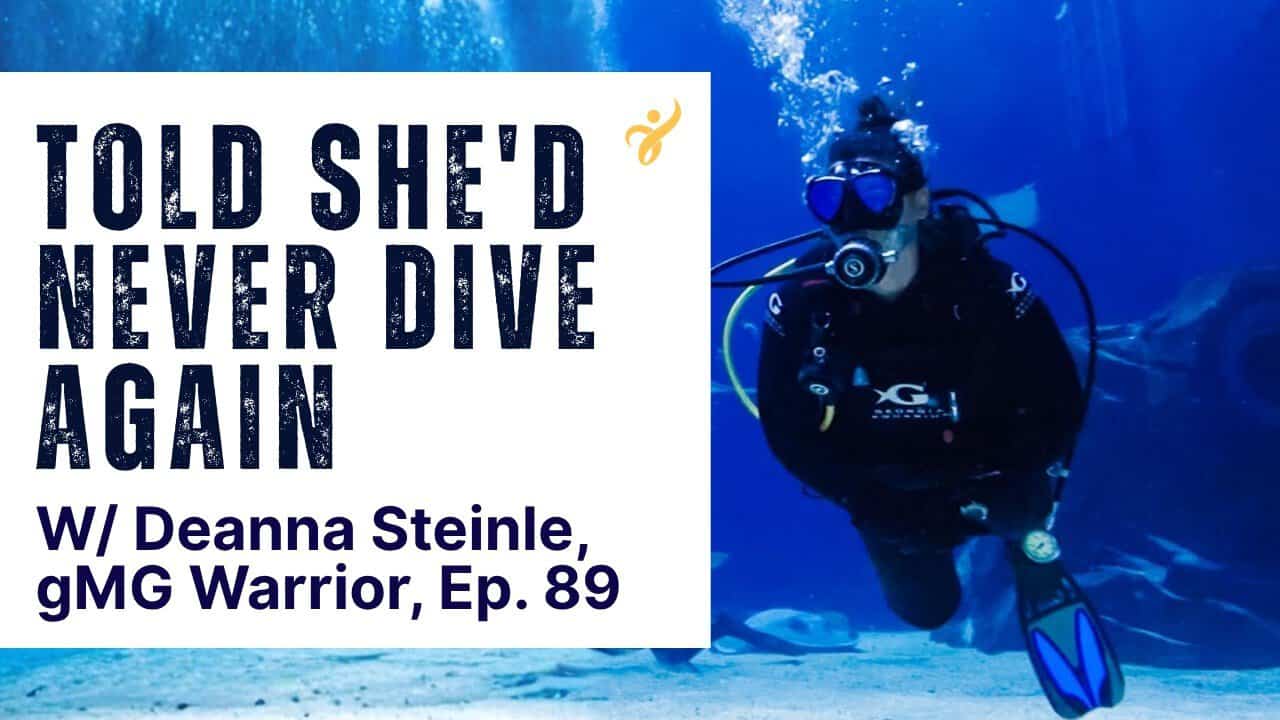
Scuba Diving With Myasthenia Gravis: Deanna Steinle’s Comeback
▶ Listen on SpotifyAbout This Episode
“You will never ever dive again.” That’s what Deanna Steinle was told after her diagnosis with generalized myasthenia gravis (gMG), a rare autoimmune condition. Her answer was, “Watch me.” Deanna was a professional diver and a PR pro, including work as a shark diver at Ripley’s Aquarium of the Smokies. On this episode of Invisible Strength, she talks with Karin and Chris about her diagnosis, the four and a half years she couldn’t be left home alone, the grief that arrived a year after the crisis, and her return to diving in 2022.
Key Takeaways
- Deanna’s road to a gMG diagnosis included an MG crisis, when her body declined rapidly.
- She celebrates her “diagnosis day” because a diagnosis brought answers and relief.
- Her grief didn’t hit until about a year later, once the new routine had settled in.
- For four and a half years she couldn’t be left home alone, and trust with her husband was key to moving forward.
- She returned to diving with disability-certified dive teams and went back to school using a disability education benefit.
Celebrating diagnosis day
For a lot of us in this community, a diagnosis is a strange mix of relief and fear. Deanna leans into the relief: she celebrates her diagnosis day. In the conversation, it brought to mind a poem about celebrating every day that something tried to kill you and failed.
Grief that arrived a year later
At first, there was no time to process. “Forget career, forget, you know, just make sure the bills are paid,” Deanna said. “It was only once the dust settled, this is going to be your routine now, that I had to start processing the grief of the life that I had. And that happened about a year after the fact.”
Get the Free RESET Guide
A flexible, judgment-free framework for rebuilding life with autoimmune disease — on bad days and good ones.
If your grief showed up late, or keeps coming back, you’re not doing it wrong.
Four and a half years of not being left alone
During her diagnosis process, Deanna went through an MG crisis, and for four and a half years she couldn’t be left at home alone. She talks about how she and her husband handled that, and about trust. “There’s a trust between your caregiver, your spouse, other people in your lives. You have to trust the person with the illness,” she said. “You have to let us live a little.”
“Watch me”: returning to scuba diving
Water was Deanna’s life. When she was told she’d never dive again, she talked with her doctors about how to do it safely. One said she could swim or dive in a swimming pool, and Deanna realized aquariums offer those same controlled conditions. She found disability-diver-certified facilities that work with adaptive divers, and teams that already knew her professional background. She got back in the water in 2022.
Going back to school at 2 a.m.
When she couldn’t sleep, Deanna wanted something she could put her energy into without getting out of bed, and a checklist she could see herself finishing. She learned that her permanent disability benefits included an education benefit, and she used it to go back to school, studying biological anthropology. She talks about what studying death and dying taught her, too.
Redefining hope
As a marketing and PR person, Deanna is wary of hope that’s been sold as something out of reach. “Hope to me is all about the present,” she said. For her, it’s small victories: seeing her grandkids, or cooking them breakfast on their first day back at school. “It all looks different. And I want people to understand that, and be like, yes, that’s celebration in and of itself.”
Follow Deanna at @resilience.is.beautiful.
Notable Quotes
Episode Chapters
- 00:00 — Intro
- 00:48 — What is generalized myasthenia gravis
- 02:47 — First symptoms and the road to diagnosis
- 05:47 — Getting diagnosed, and celebrating diagnosis day
- 07:40 — The new normal — career, family, insurance
- 10:44 — Four and a half years of not being left alone
- 12:18 — Returning to scuba diving
- 17:26 — Mental health during isolation
- 19:12 — Going back to school at 2am
- 22:10 — What studying death and dying taught her
- 25:03 — What advocacy looks like day to day
- 26:57 — Redefining hope
- 28:26 — Small victories and momentum
- 31:14 — Her hopes for sharing this story
- 32:28 — The pipe burst and the car accident
- 33:57 — Helping others communicate their diagnosis
- 38:17 — What Invisible Strength means to Deanna
- 39:30 — Where to find Deanna
Support and resources: https://www.invigorateyourjourney.com
Never Miss a Story
Subscribe to Invisible Strength on YouTube and join our email list for new episodes, free resources and support.
Join Our Email List →Frequently Asked Questions
What is generalized myasthenia gravis (gMG)?
Myasthenia gravis is a rare autoimmune disease that disrupts communication between nerves and muscles, causing muscle weakness that can worsen with activity. In generalized MG it affects muscles throughout the body.
What is a myasthenic crisis?
A serious complication in which the muscles that control breathing weaken. Deanna’s path to a gMG diagnosis included an MG crisis, when her body declined rapidly. A crisis is a medical emergency.
Can you scuba dive with myasthenia gravis?
Deanna returned to diving with disability-certified dive teams. She also went back to school using a disability education benefit. Talk with your doctor before any activity like diving.
Deanna’s experiences are personal and this FAQ is general information, not medical advice. Talk with your healthcare team about your own care.
Read the full transcript
This transcript was generated from the episode’s captions and lightly edited for readability (filler words removed, names and condition terms corrected). Paragraph breaks mark a change of speaker. It may contain minor errors.
[0:00] Hey, thanks for joining us on the Invisible Strength Podcast. Today’s guest story left me tearyeyed when I first heard it. Not only because of the immense challenges that she’s gone through, but the resilience that she’s cultivated in overcoming those challenges. And despite her rare diagnosis, she is still scuba diving, painting, and studying biological anthropology. Truly remarkable. Deanna, I’m really excited to have this conversation with you. Thank you for being here.
[0:32] Thank you so much for having me. It is a really a great honor to be with both of you guys today.
[0:37] If this is your first time joining us, I’m Karin Wagner and I’m joined by my amazing co-host, Chris Burton. Good to see you, Chris.
[0:45] Always good to see you, Karin. And so excited to speak with you, Deanna. This is going to be great.
[0:50] Absolutely. Deanna to start you had a rare diagnosis of GMG and I can’t even pronounce the full condition. Can you say what it is and tell us a little bit about it? Generalized myasthenia gravis is a rare neuromuscular condition that affects every single voluntary muscle in your body. We develop a blocker or a protein that goes into the nervous system and says, you know what, I’m not going to allow you to communicate. And so we lose that ability to contract those muscles. Some people have it just in their eyes. So the reason the small G is in front of it is because I’m generalized.
I have it all over my body. When you see the O in front of it, it means it’s just affecting their eyes. And your eyes are your most voluntary used muscle because every moment that you’re awake, your eyes are constantly in contraction. [clears throat]
[1:43] Therefore, a lot of people get diagnosed first that way because that is something that is a visible part of the symptoms that can be presented and a doctor can see that in front of them as a tangible symptom that they can be like, “Oh, that’s not correct. We have something major going on.” And so the O and the G just simply allows everyone to understand how the disease affects them in that way. Where it becomes fatal is people don’t realize that your diaphragm is a voluntary muscle.
And when you speak, when you project, when singers use every bone in their body to do those huge long notes, they are using their diaphragm, they’re controlling that. And we lose that ability to regulate that. We get so weak, we cannot ventilate properly. So, our CO2 goes up and we go into respiratory crisis.
[2:32] That’s why it’s so important to advocate because it’s not just about us not being able to lift weights or use our fingers or walk around or have to use mobility aids. There is a fatality component to this which we’ll get into this later in the podcast, but I’ve had to go through that where I’ve had to fight for my life to combat my disease.
[2:50] Yeah, absolutely. Now, as you’re articulating this, we can definitely hear the gravity of this condition. So, so talk to us a bit about how you first noticed these symptoms and what was your reaction?
[3:02] For me, it’s a little bit of a complex situation. We had been looking for something all the way back through middle school and it was just little things here and there. But fast forward almost two decades and I get married. my husband and I are on this new honeymoon stage together.
[3:23] And my world fell apart. I had a surgery that did not go well and I ended up on bed rest for 18 months. I had very hard time speaking. Had to learn American Sign Language. I actually looked in becoming a professional interpreter during that time cuz I lost my career during all of this chaos.
[3:40] Goodness.
[3:41] And I still didn’t know even through all of this trauma, they still did not know what it was. And it was not until 2017 when I had the facial features and the eye drooping and the slurred speech that they said this is not correct for a young woman your age. There’s a shorter list of things of what this could be. we have to figure this out because now we’re in this emergency category because when you start looking at the facial feature issues,
[4:08] You think of stroke, you think of tumor, you think of aneurysm, we have a very short window of things that we need to get through to make sure that the person is safe
[4:18] And that’s how it rapid rapidly progressed into the pro prognosis at that point.
[4:24] Yeah. Yeah. Absolutely. Thank you. I cannot imagine your face start drooping all these crazy symptoms. How scary that must have been.
[4:33] It is. I was thankfully working at a multi-pety practice at the time and the doctor came up to me and he was asking me these weird questions and I did not realize my eye had started to droop at that time.
[4:44] And he was just asking me things that I knew he should have known. He should have known the answers,
[4:49] Right,
[4:50] To these questions. And he was doing it in a way that wasn’t to jar me or scare me when he was kind of running through his list of protocols in his medical brain. And then he said, “Listen, you need to go look in the mirror. Your eye is drooping. You need you we need to get you some help.” And I know this was not the brightest thing to do, but at the time, my vision had not split. And that is very common with generalized misthena gravis and ocular. Your vision splits. I was trying to get to my spouse and I was driving down the road and I saw two complete images on top of each other.
The car in front of me and I just pulled over and stopped and my husband came to get me. We went to the emergency room, went to the doctor’s office and everything just was a blur from that point forward.
[5:39] I you know like you know I want you to be kind to yourself cuz you know when we’re in crisis does it’s easy to kind of Monday morning quarterback it and say you know that you shouldn’t have done that but in the moment what were you supposed to do so I definitely hear that but talk to us a bit about the diagnosis period like was it a long time in terms of things they were trying to rule out like I remember you saying that they were noting for a woman your age like this shouldn’t be going on so was there a sense of like relief when you finally got a proper diagnosis or you know what’s what was going on with that that process
[6:13] When I was officially diagnosed it there is a blood test they look to see if you have the antibbody
[6:19] And there is a part of our community that does not present an antibbody they’re called sergative
[6:25] So when I say it’s almost a double-edged sword I say I am actually very blessed that it does show in my blood work because I yes I do have to sometimes argue with doctors on certain things but there’s that barrier that is automatically taken down for me.
[6:40] Yeah.
[6:40] And there’s other people in the community that still have to fight that barrier to say, “Listen to me. This is MG. This is what is happening.” And it’s just a harder conversation. But when I did receive that, everything like I mentioned back through middle school, I had an answer for all these questions, all this is this in my head, am I overthinking this? Is this anxiety? Like which I’ve been told as a female there’s this stigma. And I was like, listen, I knew there was something wrong.
[7:09] And when I got that, I said, you know what? When I come around every year on my anniversary date, I’m going to celebrate my diagnosis. And I do. I actually celebrate it more than my birthday because I at that moment, I got true intentional help.
[7:22] Come on. That’s really real. You know, what you’re saying reminds me of the lines of a poem that says, “Come celebrate with me.” I’m butchering it now. I want to recite it, but it’s like come celebrate with me because every day that try something tried to kill me and failed, you know, and just thinking about what it means for you to celebrate that diagnosis day is incredible.
[7:43] Very much so. One piece that I’m hung up on because going through such a challenging process and then getting that diagnosis initially, yes, you’re happy that you got a diagnosis. There’s relief that comes with that, but then you start to look ahead and you’re like, “Wow, what does this mean for my life?” And you had mentioned you had to change careers and all that. So, how did you navigate that piece of it? I honestly I did it the best I could cuz there’s no right way to do it.
And I tell people in my community that you’re not born to understand how to navigate this kind of trauma or change in your life. And your dreams are kind of wisping away on a whim right in that very moment. And I was even thinking about how does this affect me and my spouse? How does it affect our family stability? How does it affect our insurance? I know now it’s a specialty. Can I afford to get to the doctors that can help me? There’s a true roller coaster of emotions that hit you in that diagnosis process.
And I was very grateful and honestly I think about it almost every day about how my husband was there for me. And I know people don’t always have that and I am truly thankful for it.
[8:57] So with it with that regard, what did that new normal look like for you all in terms of you know your family trying to make sure that you’re taking care of you trying to find out okay how am I going to continue my career and my livelihood? What did that new normal start with?
[9:14] It was what where do we go from here? It was I have always lived in the same place up until just recently I moved to South Carolina.
[9:23] -huh.
[9:23] So the doctors that I had always been around, people in my community that I may have never been a patient before, at least I had a connection.
[9:30] I had this familiar relationship even if they weren’t my provider.
[9:35] So I was able to ask a lot of people a lot of questions and that was comforting. That was a little bit of sharing the process with them. They kind of gave me a relief in that, but you really just have to take it a day at a time. And because it was such a blur and I was in a crisis moment,
[9:55] My processing didn’t really happen until about a year later. I mean, forget career, forget, you know, just make sure the bills are paid. How did we do that? We worked through it. But it was only until almost the dust settled of this is going to be your routine now. This is what you’re going to be doing. I had to start processing the grief of my life that I had. And again, that happened about a year after the fact.
[10:20] Yeah. I love that you talk about it in terms of grief because that’s something that comes up so often for us in this community is just thinking about the course we were on and the way in which an illness and a condition can just sort of derail it and you just sort of look and be like, “No, this was not supposed to be the plan.” And it just it’s so consuming in that way and just takes over your life. But as we’ve discovered, there still can be so much beauty that comes out in this new path. But there’s still a grief for sure.
[10:46] One of the pieces of your story that really stood out to me was there was a point where your condition was serious enough that you couldn’t be left alone at home. Like was that soon after your diagnosis? Can you walk us through that period? When I was going through the diagnosis process, we call that a moment of crisis. It’s called an MG crisis. and my body was rapidly in this decline. And I had experienced that prior with some other things that had happened in my life, but I didn’t have a name for it.
And thankfully, whatever the doctors did at that time, because there are some other blanketed protocols that they can do for that patient, that isn’t necessarily for MG, but when you’re sick or going through trauma, postcare, surgery, all that, they throw things at you. And ultimately that did pull me out of it. But it took a year and a half in some of those situations where in the crisis moment because they knew what I had. They were able to throw things at me that got me kind of to my baseline and they said, “Let’s start from this point and we have to kind of cater this toolbox for you.
You have to figure out what works for you, what doesn’t work for you because this is called the snowflake disease and every person is diagnosed But how we respond to treatment, what our symptoms look like, what our crisis recovery looks like, all of those things is unique to every single person, making it very hard to treat and manage. So, we just had to start building my own toolbox,
[12:16] Right? My goodness, just thinking about the complexity of it. So, what’s amazing about you and your journey is that with all of this, you’re still doing remarkable things. like you still go about like scuba diving and you’re still having your creative outlets.
Talk to us a bit about that moment in life where you said, “I feel like I’m in a place where I’m able to try these things out.” And what was it like for you that journey of whether it was like that first time you said, “I’m going to go and sit down and hold a paintbrush or I’m going to actually immerse myself in the water and do scuba diving.” What were those f first moments like for you? And what Karin had just asked about me being alone and that safety, the safety had to change for me. I had to look at it of my husband had to move his office into our home.
[13:07] And we could not comprehend the condition. It was new. Everything about it was new. We didn’t know the gravity of what the disease could do. And losing that independence was something that I was not prepared for.
[13:19] I had to reframe everything that I did, either the adventures, whether it was going diving or whether it was going on family trips, whatever it was, I have to always look at the safety component. And what does that look like? So being home alone, not an option. And that lasted for probably 4 and 1/2 years.
[13:39] That’s extensive.
[13:40] It was very extensive. He was very nervous to leave. He was very nervous to leave me alone. And something changed and we’ll talk about in a second, but there was something significant that happened in our lives to where that safety net
[13:53] Was able to be built in a way that was comfortable for the two of us.
[13:56] Okay.
[13:57] And it had to be both of us because he has lived this disease with me,
[14:01] Right?
[14:02] And his feelings are valid.
[14:03] Yeah.
[14:04] So, I had to make sure that he was comfortable, I was comfortable, and then when I go to do these adventures like diving,
[14:10] That he knew without a shadow of a doubt that I was doing everything in my power to be safe. Yeah.
[14:15] And with diving, I was a professional diver before being diagnosed.
[14:21] Come on.
[14:22] So, he knew that I was responsible. He knew that I had the training. And he knew that I was not going to do anything that was going to cause me to make myself worse,
[14:30] Right?
[14:31] He knew that there’s a trust level there in all of these components of safety. There’s a trust between your caregiver, your spouse,
[14:38] Other people in your lives that you have to trust the person with the illness.
[14:43] You have to let us live a little.
[14:45] Yeah. Yeah.
[14:47] And I hope I answered that question because I feel like those two questions kind of coincide with one another that how can you do this?
[14:55] How but when you say you can’t be left alone at home,
[14:58] Right?
[14:59] How do you structure it to move forward?
[15:02] Exactly. And I love that you lift up trust because as you were describing the choices that you and your husband made, like what came to my mind is that sense of like mutual respect, you know, just and I think that the sort of default and it’s a loving response. I believe at its core, but the default is when a loved one gets sick or when you get sick, your thought is like, well, I just need to stay right here. I’m not going to go anywhere cuz outside of this box I’ve made for myself is this danger and chaos.
But being able to have that trust for each other and respect for each other to say, “No, I know you’re great at this before this. Let’s go back to see if we can still do this.” I think that’s such a profound example for others who are thinking what they’ve lost. Going back to that grief point, what they’ve lost and what they can actually reclaim.
[15:46] And we always have to look at it as the adventure you have in your mind and your expectation is one thing.
[15:52] But with a diagnosis, what does the reframe look like?
[15:56] Right. Right. Right.
[15:57] And that’s what I did. So, I was a professional diver. I did all these things. I was a shark diver for Ripley’s Aquarium of the Smokies. I was an education specialist. I loved it. Water was my life. And they said, “You will never ever dive again.” And I said, “Watch me.
[16:11] That’s it. That’s it.”
[16:12] So, watch me. In the beginning, it was easier to ask for forgiveness than permission. But I did talk to my doctors about it. And I said, “How can we do this?” And they gave me all these things of nos. You can’t do this. You can’t do this. You can’t do this. I said, ‘Well, basically, you’re saying that I can swim or scuba dive in a swimming pool?
[16:31] Yeah.
[16:32] And he goes, “Yeah, pretty much. Have at it.” [laughter] And but what he didn’t understand was is that I knew that those same conditions,
[16:42] Right,
[16:43] Are aquariums.
[16:47] And there are certain facilities in the country
[16:50] That are disability diver certified facilities.
[16:53] Come on. That’s really good to know. They work with wounded warrior projects. They work with adaptive divers. And because I had that professional background, the teams that I had been with before in those professional setting as an employee, they knew that I was not going to dive unless again I was safe.
[17:12] Yeah.
[17:14] And there’s that trust again,
[17:15] Of course. And I have now been able to successfully do this one, if not two times a year since being back in the water since 2022. Amazing.
[17:25] That’s incredible. Truly amazing.
[17:27] I can’t stop thinking about how you were stuck in a house for 4 years and what that would do to your mental health, especially with how much you love being in the water. So, how did you take care of yourself mentally during that time? When I was quote unquote stuck in the house, there were obviously times I was out, I but my life had changed. The touch points of being like with an employer or going to activities all the time or going over to people’s homes all the time, those dwindled significantly. And like you mentioned, there’s this mental aspect of losing touch points with society.
You’re losing that connection. My husband again championed me and anything that I was requesting, anything that I was wanting to do, we either reframed it and adapted. We brought the technology into my home to help me communicate with people from the outside or he just looked at me and he said, “I know this is a dark time. I’m sitting right here beside you. If you’re home, I’m home.”
[18:29] And that is really special.
[18:30] No doubt about it. It is a relationship core that when you are in a marriage you have to be like I married the right person.
[18:39] For sure. Absolutely.
[18:42] You know what you’re saying Deanna reminds me of the words I said to my wife when I was first diagnosed with lupus and was like I didn’t know we’d be talking about for sickness and health so soon. You know like you get up there and you say those vows and you’re like later. You know not when I’m young. this is going to be like at the end of it, but no, sometimes it happens at the beginning of the story and becomes like the definitive aspect of the story. And I just think that’s such a remarkable example of this commitment to each other. So, I just wanted to take note in that.
But I’m also just thinking about, you know, your pursuit of education and going back to school and studying biological anthropology, like what made you need to scratch that itch for education and say like, you know, I can do this and what obstacles came up along the way that you didn’t foresee? When Karin was talking about being in a building, stuck, isolated, I knew that my mental health had to be challenged
[19:44] In a positive way,
[19:46] Right?
[19:46] I was being Yes. I was in therapy. Yes. I was having the professional conversations and I was sleeping a lot.
[19:54] So, my sleep cycles were all over the place.
[19:57] Yeah. But when I was awake in the middle of the night, 2 to 5 in the morning, when the world slept,
[20:02] Right,
[20:03] I thought I have to have something that I can put my energy towards. That doesn’t necessarily mean I have to get up out of bed,
[20:10] Right?
[20:12] And I also need something that is a checklist,
[20:14] That I can actually see that I accomplished the goal. And a lot of people don’t realize that with their permanent disability benefits, there is an education benefit attached to it. and I was able to utilize that and the place I received my first degree and it was awarded to me. I worked with them and said, “Listen, I want to come back. I’m permanently disabled. I am going to use this education benefit. How do I do this? And what does it look like? Does anything change because I use this benefit?” And they said, “No.” And they broke it down for me.
And they said, “What do you want to study?” And everything I’d done up until this point, I was in business. I’d worked in several different types of industry. And I’d been speaking for a very long time. And I knew that I wanted to be specifically looking at humans.
[21:00] Yeah.
[21:00] And I specifically wanted to look at culture and their biology in the same breath because those actually trigger decisions whether that’s in relationships. When you’re talking about chronic illness,
[21:14] It talks about why they may or may not accept a treatment, why they may say no treatment.
[21:21] Right. Right. and where does that stem from? But then also how does that affect the generations down the road?
[21:28] For sure.
[21:28] That all came together in a beautiful package and I’ve been working on it for 4 years now and I graduate in December.
[21:36] Congrats in advance.
[21:38] Thank you.
[21:38] And that just sounds fascinating,
[21:41] Doesn’t it?
[21:42] We talk about health disparities. We talk about unequal access to care. We talk about which is the study of death and dying in cultures.
[21:52] It truly is everything that I do in my advocacy work.
[21:55] And to be honest, if I had known that this existed when I first went through college the first time,
[22:02] I would have done it then because it really was everything that I’ve been searching for and I’m extremely passionate about which is why I’m doing what I’m doing now.
[22:09] Right. Very
[22:10] Very much so. I’m curious with such indepth study and how it relates to chronic conditions, have there been mindset shifts or changed your perspective and how you’ve thought about certain situations with your condition? When we did the thantology class, the study of death and dying, it really changed how I looked at mortality. It was the hardest and best class I ever went through
[22:36] Because I do advocate for people to have their wishes written out. And those come with a decision-m process that comes from where you live, that comes from family, that comes from culture, that comes from lived experiences. All those things build into making those decisions. And we had to actually do all that for ourselves in that class. And I so appreciated it being in an academic setting because I could compartmentalize and handle it in a different way than being at home in my bedroom alone.
[23:09] Right?
[23:10] Having these internal dialogue and saying, I don’t know what I want for me.
[23:16] I never thought I’d have to face those questions at this young of an age. What is that what does advanced directive look like? I don’t know. I don’t know what my options are, but I want to speak for me down the road. I don’t want someone to speak for me.
[23:30] It has to be sobering, particularly when we’re young, to consider our own mortality. As you are making those plans, like how did you deal with it because even if it’s just for a class and an academic exercise, like you’re thinking about this as something that you actually need. So, how were you able to deal with that emotionally?
[23:50] Through my faith.
[23:51] Yeah. And it was something I leaned on heavily. My husband is in ministry.
[23:58] And I have been at bedsides at the hospitals for over 87 end of lives.
[24:03] Yeah.
[24:03] I’ve sat and held people’s hands. I have been at every one of those funerals except for two. And I knew what it looked like and I knew what I wanted to have for me at the end. And when you have that, I had this piece about it that came out of I It was a piece that I wasn’t expecting that I needed.
[24:23] And so by being able to study it in that way and study culture and study the health disparities and study the gaps that I talk about so often because there’s terminology that I had been speaking about, but I hadn’t had the formal words for them. So in those classes again everything that I was doing is lining up to build upon my advocacy and the work that I’m doing which empowers me to help other patients not to make the decisions for them not to tell them what to do but just say you know what this is part of life whether you have a chronic condition or not this is part of life
[24:58] Right
[24:58] And I want you to have the same kind of peace that I have seen on so many others when that time is there.
[25:05] Absolutely. Can you share a little bit more about what your advocacy looks like on a day-to-day basis?
[25:11] I always say my advocacy is multiaceted.
[25:16] It started, you know, what I consider the traditional online advocacy work, but I’d already been a speaker prior to that. I was in pageantry circuits. I was in public relations. I spoke for industries. I spoke for companies before diagnosis. So, I had I say the person I was before diagnosis built me the foundation to be who I am today. And I almost hate the way that people say, “Well, the person that was there behind diagnosis, that person’s gone. She’s dead.” No, she’s every part of me that made me just exactly who I’m meant to be in this moment.
And so when I talk about the advocacy part, I let my years of experience, my education, my professionalism guide that into basically three parts. I have my inner circle, which is my providers, my caregivers. That’s advocacy. That one-on-one conversation with your doctors is advocacy.
[26:12] Then I I go outside of that circle a little bit more. I go into my online community. I talk about the foundations and the associations that are for MG. I connect with that and advocate in that space and then I go on into industry and policy. So any given day I’m working in those three realms and and it’s been really a beautiful experience. I never thought that we would be here and even so I’m in an international film that we did for MG.
[26:41] Come on. that’s all over the world now because Alexion championed the patients to do this incredible thing and share what we know in the present.
[26:53] And I love that so much.
[26:55] Yeah. You know, as you’re doing your advocacy and engaging with folks who are in this community, whether they’re caretakers or those experiencing this condition, how do you communicate hope to them? Especially for folks who may not have as you talked about relying on your, you know, your faith, but how do you communicate to folks like there still can be life after diagnosis?
[27:18] Hope to me is all about the present. And yes, there’s hope in the present, but sometimes I feel like in even and I’m a marketing person. I’m a PR person. I think sometimes that the hope is commercialized to this thing that is unattainable. You look at it in these movies and video or you know these TV shows and movies and they go it’s out there and people are longing for that and they’re sitting alone at by themselves on a couch. They like it can’t be me. I don’t have that. And so I want the hope to be something that they feel from an internal dialogue.
It’s not something that they have to create. Just like I was talking about the person that built me into who I am today. That’s my hope.
[27:57] That what I’ve gone through I’ I’ve survived 100% of my worst days. I’m doing what I love and that I got to do this today.
[28:07] Yeah.
[28:07] And that just fuels this hope of what does the next day look like
[28:12] And the next day.
[28:14] Because G is so pendulum swinging of how bad it can be one day and how great it can be the next
[28:21] That I’m not here to tell you what that future looks like.
[28:24] I just want you to have hope in yourself,
[28:26] Right?
[28:27] And that strength.
[28:28] Absolutely. So on your worst days, did you always have this sense of hope or were there periods where you were lacking? And if so, how did it come within for you? I will never ever say that I did anything right. I did not have a golden compass. I did not have the right things in place. I had my counselors. I had my doctors. I had my family, my spouse. when you have those periods of darkness and this is going to be truly customized to every person. I leaned into my faith and my family and when I forgot who I was because MG can try to rob you of your identity.
[29:08] Sure.
[29:09] Any chronic on any chronic illness will try to rob you of that,
[29:12] Right?
[29:12] I had to communicate and that’s on me. I had to communicate how I felt and they were able to champion me back and say, “Look, look what you’ve done. look what you’re continuing to do. It really sucks today, but we’re going diving in six months.
[29:27] Right. Right.
[29:28] As long as I had something that was on the calendar, even if I had to cancel it later because my MG was mad, we had to have something to say, but look what you’re going to be doing. If that makes sense. So again, you’re looking at the present. You’re talking about being in that really, really dark moment. How do we get you to that momentum of moving forward? And as long as you had something on the calendar that had a touch point, a connection, something that fueled that joy. It always somehow brought me back around.
I think what you’re talking about is like even if you we can set goals for ourselves, but even if we don’t hit or reach those goals, there’s so much joy in the process of moving forward and feeling like you’re still a valuable person. I give you credit for acknowledging that you needed something to work towards even if it didn’t pan out.
[30:23] That’s the reason I went back to school. It was something that I said despite my condition, despite what this looks like, even if I hate just take one class at a time. Don’t care how long it takes me. It was just the simple fact of you have to keep some momentum in that dayto-day. And that could be I know people in my community that are grandparents and part of their dayto-day for that momentum is I get to see my grandkids in 2 days. I get to do this. I get to cook them breakfast on their first day of school starting back. It all looks different.
And I want people to understand that and be like, “Yes, that’s celebration in and of itself.”
[30:59] Yeah. No, I just love you lifting up those like small victories. And what I’ve often talked about is the miracles in the mundane, things that we would take for granted otherwise, but because of what we’ve gone through, you can have an extra deep appreciation for. And so I’m just curious to know with this your story being shared, what are your hopes for the ways in which this story is going to meet people, whether they are folks who are making decisions about funding for research or people who are learning about a diagnosis of a loved one. What’s your hope for this story being out in the world?
[31:34] That is such a loaded question, Chris.
[31:36] Yeah, it is.
[31:39] Such a loaded question. I there’s two things. One, resilience is beautiful as my platform, and that’s what I live and breathe every day.
[31:47] Sure. And if it brings a smile to someone’s face in their darkest moments, not about my particular illness or what I’ve done that has really been dark, but the things that I have championed myself to accomplish and just share the joy of that, that’s amazing. If someone can hold on to that and see that within themselves,
[32:09] That’s a goal. But the other part is when you’re looking at the film and you’re talking about the communication, the relationships with people, there’s nothing more important than the relationships in your life. Jobs come and go. Careers, homes, people move,
[32:26] Buildings come and go. You get emotionally attached to things. Something that you all get, you all are going about to get an explicit special thing that I’ve never told anybody on a podcast.
[32:36] Come on. During my diagnosis process, a pipe leaked exploded at our home and we lost 80% of everything that we own.
[32:44] My goodness.
[32:45] And then two weeks later, my husband, my service dog, and I were in a serious car accident and lost our vehicle all at the same time.
[32:53] Oh my.
[32:53] My service dog was okay. She was mentally shaken, but physically she was fine. I think about that moment in time.
[33:00] When I watch the film, and I The film is broke up into three sections. I’m with my best friend, someone’s with their mom, and then someone is with their spouse.
[33:10] All of that got wiped out from underneath us in the middle of trying to figure out how to help me with my diagnosis.
[33:16] Yeah.
[33:17] Loss of career, lost 80% of everything that we own, lost a vehicle for transportation. You could not have hit us any lower.
[33:25] Come on.
[33:25] Than what we were at,
[33:26] Right?
[33:27] But the people that stepped up for us, and that’s exactly what this film is about. the people that are there that love you no matter what that say, I see your condition and I respect it and I am here to help you.
[33:43] But I see you as a person
[33:45] And what you can achieve. That’s what people need to really focus on because in those dark moments, they’re the ones that are going to pull you out of it.
[33:54] That’s fantastic.
[33:55] Very much so. And those relationships, to your point, are so vital to helping us get through these conditions. With you being such a strong communicator and what you do for a living, I’m curious how you help people cuz a lot of people have a hard time even talking about their condition. And with this being a rare disease, how do you help them figure out how to communicate with friends, families, co-workers, all the people in their circles about a condition that a lot of people don’t know a lot about. The easiest way to start is to understand what makes you nervous.
And I say that because there’s a social anxiety component to explaining to someone what you have, what your condition is, what your limitations are.
[34:42] And when I look at those conversations now, and this has taken a decade for me to learn. This is not something I had to learn overnight
[34:49] For sure.
[34:50] But I had to understand where did my energy go to those individuals because you can explain to someone all day long, but if they’re not ready to hear it, they’re not really that interested. They’re not going to be impactful in your day-to-day life. They’re not there to support you. They’re really actually in it for gossip. And I have been there. I’ve gone through it.
[35:09] I’m not going to use my energy there. And your gut will tell you that anxiety, that nervousness, and the question is, why do I want this person to hear me?
[35:20] That catapults the whole conversation.
[35:23] That’s such wisdom because you learn early on when this crisis of health happens, there is almost a shock, at least in my experience, that the world just kept on moving. And so if people ask you how you doing, there’s a temptation to really say how are you doing? And after a while, you realize, oh, a lot of people don’t actually care. And so it makes the people who do care so special and remarkable, but it also helps you become a more discerning person where you’re not just like spilling everything out for people who don’t have any compassion for your situation. They just want the tea.
Yeah, I love that perspective because it takes you out of your own feelings and considering where the other person is at, but then gives you a great way to understand when it is okay to share and how much to share. So, that’s really helpful advice. One of the greatest examples that I can give because I don’t want it to go into the family or relationship sector for the example.
[36:22] Look at two providers. I have two providers that have very different personalities. Yeah,
[36:28] Very different personalities and I had a question or a concern about my condition and I felt like one of the two was not hearing me.
[36:38] And what I was saying there was like a disconnect and not because they didn’t care but their brain wasn’t thinking that way.
[36:43] Yeah. Yeah.
[36:45] And I stopped myself. I said, “Why do I want them to hear me?” And what it boiled down to is that I wanted them to empathize. There wasn’t a fix that I wanted from him. So my other doctor who is a little bit more emotionally intelligent,
[37:01] I communicate it to him. He hears me. We have that dialogue. I get it off my chest. I’m not sitting with that feeling by myself. I have no qualms with the other person that my other provider love him to death
[37:13] For sure.
[37:15] But I had to stop and say, why am I wanting to hear me? Did it change anything about my treatment? No. Did it change anything about my day-to-day? No. But there was just something that was nagging me that I wanted them to understand. So when you can look at it in that example or an analogy, you’re looking at two different people, very different ways their brains work. Why do I want them to hear me? And really, it came down to I just needed the validation. And I could get it, but just from a different person.
[37:42] Yeah.
[37:43] It reminds me of a fellow lupus warrior told me that her and her friends will ask, “Do you want to be heard or do you want to be helped?” And that way they can respond in a way that they want to be interacted with.
[37:57] Yeah. Yeah. Love that.
[37:59] That’s great. Yeah.
[38:01] Yeah. She was in her 20s. I’m like, you are already so wise.
[38:06] Head of the game.
[38:07] Oh, if we all could be that bright,
[38:09] You know? I wish I had that.
[38:12] That’s something that you either learn it by fire or you’re just born with it. I feel like she was born with it.
[38:17] Yeah. Right. Deiona, I want to ask you, what does invisible strength mean to you?
[38:22] Man, you all have come in with a load of questions today. Let me tell you, I think it has to do with claiming back my identity of who I am in my condition because the world may not see what I do every day. They may not see the things that I struggle with. Use my wheelchair, use mobility aids, use my seats in my shower, not be able to cook dinner for my spouse. Like last night, there was no possibility of me being able to cook dinner for my spouse.
They may not see any of that, but what they did see is that we sat on the couch together and we had the most amazing conversation about our day and about what made us happy and about this podcast today and so much joy that was happening in that moment of I felt absolutely awful, but my spouse and I had this amazing magical night no matter what. And that’s invisible, but almost to the point of it’s okay that the world didn’t see it.
[39:16] It was precious. It was for us. And so invisible strength, I just sometimes feel like we fight so much to be seen about this invisible illness. Absolutely. I get it. But sometimes it’s almost so precious that you got to use that for yourself to fuel you on to the next day. Beautifully said.
[39:32] Yeah.
[39:32] Right. My goodness. So Janna, how can we support you going forward? Like where can we find if the film is available to be a scene? Where can we watch that? Like tell us all the things. All the things.
[39:45] Well, I am on all the things.
[39:47] I I am on Instagram. I am on Facebook under resilience is beautiful. Or you can just search my name on LinkedIn. I share a lot of the journals that I’m in or quotes from articles that have been published. The film is there. My speaking events are there. So on LinkedIn that’s just my name and I it’s not under resilience is beautiful. The film itself is connected to every one of those platforms, but it lives in its own spot on Alexian’s global channel on YouTube and it’s called the rare connections. GMG,
[40:19] Thank you for sharing that.
[40:21] Yeah, we’ll also drop those in the show notes, so make sure you check that out. Deanna, like I said in the beginning, you are truly a remarkable person and I’m so inspired by your perspective and resilience. Thank you so much for being here. Thank you, Chris and Karin. This has been such a joy and it’s always the best feeling when you end a podcast and it is this familiarity that sticks with you and I know that this is one of those days and I’m so grateful to be with you guys and connect and can’t wait to see what all of us get to do together
[40:54] In the future. So, thank you for having me and I have two new great friends going with me on the journey.
[41:00] There it is. No, it’s an honor to chat with you.
[41:03] Love that. And as always, thank you, Chris, for being here.
[41:07] Yeah, we have a great time over here. So, no, thank you.
[41:10] If today’s episode resonated with you, please share it with someone who could hear it. And then we are offering coaching services and other support for anyone going through a chronic illness journey at invigorateyoujourney.com. So, make sure you check that out. We will see you next Wednesday on the Invisible Strength Podcast. Take care. Peace. Peace out.
Medical disclaimer: This post is for education and shared experiences only and is not medical advice. Deanna returned to diving with her doctors’ input and specialized dive teams. Always consult your healthcare team before making changes or starting a new activity.

