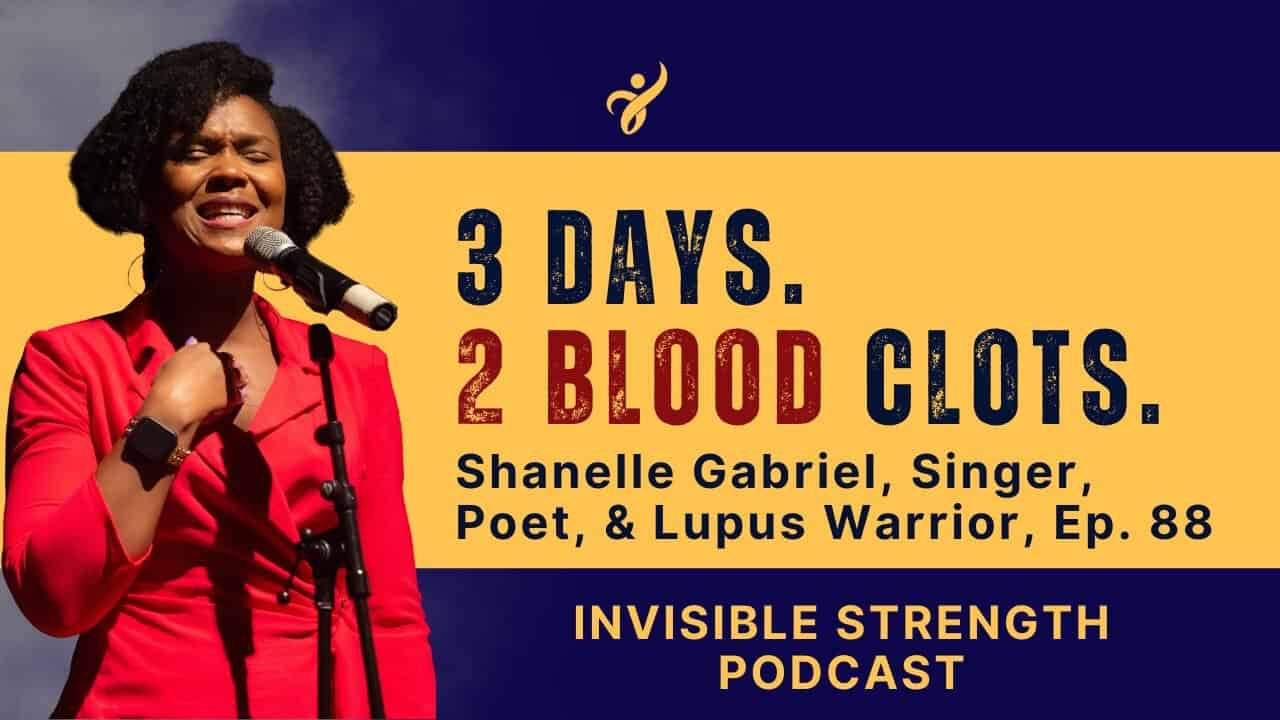
Lupus & Blood Clots: Shanelle Gabriel Performed 3 Days Anyway
▶ Listen on SpotifyAbout This Episode
Shanelle Gabriel has performed at Carnegie Hall, at the Vatican and on HBO’s Def Poetry Jam. She’s also lived with lupus since 2004, and about 10 years after her diagnosis she developed antiphospholipid syndrome (APS). On this episode of Invisible Strength, the Brooklyn-born poet and singer talks with Karin and Chris about the year of symptoms she explained away, the three days she performed with two blood clots in her lungs, and why she believes every newly diagnosed person needs a mental health professional.
Key Takeaways
- In college, Shanelle wrote off headaches, joint pain, hair loss and brain fog, even telling herself she was “getting older” at 19.
- She was diagnosed partly by luck: her primary care office was right next door to a rheumatologist.
- She performed for three days while carrying two blood clots in her lungs, a lupus-related complication called APS.
- She’s learned to see her worth in “the gift” she brings, not in any single title, including “patient.”
- Her advice for the newly diagnosed: find a therapist, not just a support group.
“I’m getting older. I’m 19.”
Shanelle’s first symptoms showed up in college: headaches, joint pain, hair loss and brain fog. Her fingers would turn white, hurt and then turn red, and she assumed it was because she was cold. “All the things I excused all ended up being symptoms for lupus,” she said. “I was just like, ‘Oh, I’m getting older. I’m 19.’”
Diagnosed by the rheumatologist next door
Her primary care doctor happened to be right next door to a rheumatologist, and that doctor knocked on the rheumatologist’s door. She came over and said, “Everything is swollen on you.” Shanelle knows how lucky that was. If it had been anyone who didn’t see lupus regularly, she says, “the way that I kind of slow-rolled my symptoms, I would have never gotten diagnosed.”
Get the Free RESET Guide
A flexible, judgment-free framework for rebuilding life with autoimmune disease — on bad days and good ones.
Three days with two blood clots in her lungs
Years later, she ignored a pain in her side and figured it might be pleurisy. “For three days I walked with the pain of having two blood clots in my lung,” she said, “just walking with the pain, ’cause I was like, ‘I got a show.’” Even in the hospital, her first question was whether she could make it back for that night’s performance. “It’s like your body is fighting your brain,” she said. Her body was saying it couldn’t, and her brain was saying it could do everything.
That story is a powerful reminder: pushing through isn’t always strength. Sometimes the bravest thing is to stop and get care.
The gift, not the title
Shanelle has had to pivot many times because of her health. What helped was letting go of titles. “It’s really not the title, it’s the gift that I’m bringing to it,” she said. That includes not clinging to “lupus” as the sole definition of who she is.
Why she says to find a therapist
Shanelle wishes someone had told her this at diagnosis: “No one ever recommends a therapist to help you transition this. No one ever suggests that.” When she did go to therapy years later, for something else, she found herself talking about lupus and identity much of the time.
Shedding what no longer serves you
She also talks about the ongoing “shedding” that living with lupus requires, of commitments and even relationships that don’t support your health. “There’s a shedding that has to happen where you’re like, okay, this thing was cool, but this might not be working for me right now.”
What invisible strength means to Shanelle
“Invisible strength to me is the strength you have when no one’s looking, when no one’s going to applaud you for it,” she said. “No one maybe knows everything you’ve accomplished, or everything that you battled, or every dark night that you dealt with. But somehow you are still standing.”
Shanelle is working on a book and a fourth album. Follow her at @shanellegabriel.
Notable Quotes
Episode Chapters
- 00:00 — Intro
- 00:59 — Meet Shanelle: Brooklyn roots and lupus since 2004
- 02:16 — From singing in the hallways to Def Poetry Jam
- 04:47 — Performer, communicator, lupus warrior
- 06:15 — First symptoms in college: headaches, joint pain, hair loss
- 09:04 — Diagnosed by the rheumatologist next door
- 12:16 — Performing in pain
- 13:28 — Three days with two blood clots in her lungs
- 15:55 — Pivots: building systems and letting go of guilt
- 18:15 — Who am I now? The gift, not the title
- 22:09 — Silver linings: managing other people’s energy
- 24:42 — Advice for the newly diagnosed: find a therapist
- 27:52 — A hopeless optimist
- 30:42 — How to talk about lupus with friends and co-workers
- 32:43 — What’s next: a book and a fourth album
- 35:21 — The milestone she didn’t think was possible
- 38:38 — Shedding what no longer serves you
- 41:20 — What invisible strength means to Shanelle
- 42:06 — Where to find Shanelle
Free resources: Grab the free RESET Guide (https://invigorateyourjourney.com/reset-workbook) or take the free 2-minute Journey Quiz (https://invigorateyourjourney.com/quiz/).
Never Miss a Story
Subscribe to Invisible Strength on YouTube and join our email list for new episodes, free resources and support.
Join Our Email List →Frequently Asked Questions
What is APS and how is it related to lupus?
Antiphospholipid syndrome (APS) is an autoimmune condition that raises the risk of blood clots, and it can occur alongside lupus. Shanelle performed for three days while carrying two blood clots in her lungs.
What were Shanelle’s early lupus symptoms?
In college she wrote off headaches, joint pain, hair loss and brain fog, even telling herself she was “getting older” at 19. She was diagnosed partly by luck: her primary care office was next door to a rheumatologist.
What is Shanelle’s advice for the newly diagnosed?
Find a therapist, not just a support group, and see your worth in the gift you bring rather than any single title, including “patient.”
Shanelle’s experiences are personal and this FAQ is general information, not medical advice. Talk with your healthcare team about your own care.
Read the full transcript
This transcript was generated from the episode’s captions and lightly edited for readability (filler words removed, names and condition terms corrected). Paragraph breaks mark a change of speaker. It may contain minor errors.
[0:00] Hey friends, thanks so much for joining us on the Invisible Strength Podcast. We feature all sorts of autoimmune and chronic illness warriors who are accomplishing great things with their conditions. Today’s guest is an internationally touring poet and singer. She’s performed at places like Carnegie Hall to the Vatican, which is incredible. I can’t wait to hear more about that. She’s also been on HBO’s Def Poetry Jam, which is way cool.
[0:30] Yes.
[0:30] She’s a fellow lupus warrior. Shanelle, we are honored and excited to have you on the show. Thanks for being here.
[0:37] Thank you for having me. I appreciate it. I appreciate it.
[0:41] It’s our pleasure. And if you’re new here, I’m Karin Wagner. I’ve been a lupus warrior for almost 20 years and I’m joined by my amazing co-host Chris Berton, who is also a fellow lupus warrior. Chris, good to see you.
[0:54] Hey, good to see you as always, Karin. And Shanelle, I’m so excited to talk to you today. This is going to be great.
[0:59] Hey, absolutely. So to kick us off, Shanelle, can you just share a little bit about yourself?
[1:04] Well, my name is Shanelle from Brooklyn, New York, born and raised.
[1:08] Yes.
[1:09] Yes, Brooklyn’s always in the house.
[1:11] Always in the house.
[1:13] I was raised always giving love to my heritage. I was raised by Trinidadian parents. I grew up in a Caribbean household and I had I started out in college studying communications cuz I like talking to people and I somehow continued to find a way to continue to talk to a whole lot of people at once. I’m a poet and a singer. I do a lot of work in and around education using the arts as well as education around living with lupus. And so, I was diagnosed in 2004.
I don’t want to get too deep into that cuz I know we’re going to probably have a little more of a conversation about that, but I’ve had lupus since 2004 as well as developing lupus anticoagulant lupus syndrome. And I don’t always speak about this part, but I’m starting to speak about it a lot more. I also have fibroids and deal with that. just, you know, reproductive issues and that’s something I think, you know, when you’re dealing with a one chronic illness, you kind of always over index on the one that’s you’re usually annoyed by the most.
The other one is starting to be annoying, too, and deserves some love, too, so.
[2:17] No doubt. No doubt. You know, thinking about just like growing up in Brooklyn and how music is everywhere around us. And then just like the amount of like lyricists, whether they’re, you know, rappers or singers or poets. When did it become personal for you in terms of becoming a passion and then when did that passion become your career?
[2:35] So, I was the kid, the way that people knew me my freshman year of high school was I would walk in the hallways going to the bathroom and would be singing. Like, everyone knew it was the girl that sang in the hallways. I’d be like, “It’s so I get so weak.” You know, whatever it was. That was Just walking up in that. Everyone knew me as that. to the point where like we had a talent show, performed at that. I grew up in church and my sister, I always give her all credit and props.
my sister Roxanne was a children’s choir director and once that happened, I had no choice but to be a part of the children’s choir. It was not optional. Go and help your sister, you know, that was it.
[3:13] Exactly.
[3:14] And so, I just developed a love like I I credit her for my love of music because I had to help her teach all three parts. Like, I knew soprano, alto, and tenor. I had to know everything and learn and help her teach when I was like 10.
[3:27] Come on.
[3:28] She was like, “You’re way older than me like the note.” And so,
[3:31] Yeah.
[3:31] It just fostered this love of music and I just found music as a place for a lot of self-expression. I wrote for myself, not for anybody else, really. And then years later, when I got to college, I was just like, “Oh, the music industry is kind of shady.” I worked with a lot of different artists and did hooks for random rappers. Working out of like a studio that was in my neighborhood and
[3:54] Yes.
[3:55] I just stopped loving that and I yeah, I sang the anthem at the hockey games at in college and the basketball games in college and
[4:02] Yeah.
[4:03] I sang the national anthem at my grad college graduation, you know, it just became a part of me and but the music industry was just not what I wanted to be a part of and so that’s where poetry jumped in and it became like, oh, I could do these two together, these relate to each other, they’re all about connection. And so when I was graduating, I’d started already doing poetry and then Def Poetry happened and I think that was the only reason why it was okay by my family to do poetry. Like, oh, you’re on TV. Okay, you can do it now. They were very much like, you need to get a real job, you know.
[4:37] So it moved into that space and that’s when it became a career for me where I grad- I graduated college and went on my first tour a year later.
[4:46] Awesome.
[4:47] Incredible.
[4:48] So you have a few different things going on, singing, poetry, you also describe yourself as a communication expert and a lupus warrior. I’m curious how you think about identity with all those various lanes.
[5:02] It’s such a hard pull. I spent a lot of time arguing with people who told me I need to figure out one thing. I’m like, I’m from New York, we’re a land of multi-hyphenates, you know, everybody does I’m a part-time this, part-time that. You know, but they all fit very well together. Just like I said, the communication part of it was the thing that I loved about performing. It’s connection, it’s the idea of building connection.
And you know, I did that I learned that pragmatically in school which, you know, lent itself to some of the creative work that I’ve done with brands like Pandora, the NFL draft, you know, I’ve done things with each of these. Understanding communication helped me understand how to create for an audience. And then it made me also understand that when I’m speaking to an audience, how do I want to connect with them?
And so, when I started talking about lupus, that lent itself into that speaking lane and that part of the connection with my disease and you know, others dealing with the disease as well. So, it all fits and I try to just say that I’ve I just love people. I’ve always loved people and it’s just all allowing me to connect with people in so many different ways and connect other people to things that they need to hear and things that I think would be helpful for them or things that helped me.
[6:14] Absolutely. Absolutely. You know, we often say on this show that we’ve yet to come across any, whether it’s a lupus warrior or folks living with autoimmune disease or disorders who are just like, “Yeah, I don’t do much. You know, I just kind of just hang out.” You know, it’s always the multi-hyphenates folks who are just, you know, you know, burning the midnight oil or are getting to it. So, I’m just curious to know, you know, take us back to, you know, 2004, if you will, and you’re first diagnosed with lupus.
What were those first signs that something wasn’t right and what was going through your mind at that time? Like, what were you noticing within yourself?
[6:51] Well, I was in college. So, this is my that I can remember it mostly in my sophomore year. And I had these headaches. I always start off with like just remembering how bad these headaches were.
[7:04] And I’d be sleeping and I’d just be like, “Ow.” And I’d open my eyes and it would just be a wave of pain just there. And I mean, I get up and I’d put a compress on my head. I would try so many things that I remember like crying in the bathroom in my dorm room. And my roommate was still asleep. And I that was the first symptom that I got that was something’s wrong. But, I ignored it a little bit. I did go to the on-campus doctor who, let’s be real, is not trained to necessarily try to give a diagnosis for a chronic illness.
[7:37] [laughter]
[7:39] They’re for STDs [clears throat] and
[7:41] Exactly. Different class of issues. Other stresses. All the other things you know that college students deal with. That’s right.
But yeah no I really was like okay I had these headaches and you know she kind of said oh it’s probably a sinus infection here’s you know something for that and I also noticed I started having joint pain and I remember waking up and being like Shanelle physically get up and it wasn’t like sleep paralysis it was like my body felt like a board and I’m like all right I’m trying to get up and everything just hurt and I was like okay let me just lay here a little longer and you know I started being late to class a little bit.
And so those were like the initial symptoms but I always say it wasn’t until I lost my hair that I went to the doctor.
[8:26] Hair loss I had finished up school out that semester I went home I was like maybe I just need to sleep and that’s all I kept telling myself maybe I just I’m just working too hard. I was running my campus you know and when I finally I got home and I was combing my hair there were patches gone all over the hair this was pulled back I didn’t notice it until I started being like wait there’s a patch here gone too and then I made an appointment the next week it was like don’t worry about the other stuff just fix my hair and that’s literally what I said about the other stuff.
I have some other things I want to talk to you about but we don’t need to talk about that now because you need to fix this and then we can talk about it.
[9:06] Isn’t it amazing that you were able to get into a specialist so quickly? Right.
[9:12] That was a primary care I didn’t even get to the specialist yet but I was lucky in that sense that my primary care literally is next door to a rheumatologist. I say is God okay because I know that if I didn’t if it was anyone else who did not see lupus in their office on a regular basis especially the way that I shared my symptoms the way that I kind of slow rolled them I would have never gotten diagnosed.
[9:36] Right place, right time.
[9:40] Yeah, I was curious. Were you able to get a diagnosis quickly since you were right next door? Well, at that point in time for a year later, yeah, I was he looked at the hair loss and was like, “Oh, this is weird.” And that’s all he said. I just remember him saying it’s weird and I remember going, “Oh my gosh, I have like a disease that one person in the world has or something rare.” And he was like, “Let’s do some blood work.” but my blood work was so glaringly autoimmune. Like my white blood cell count was crazy. I was severely anemic.
And he was like, “Do you eat, you know, I was like, I eat meat.” I was like, “I’ve been trying to donate blood to the blood drive and it keeps sending me back home, you know, I that’s how active I was on campus. I’m like, “Please take my blood.” And they’re like, “No.” I’m like, “Why?” But all of that, the ANA being positive, I had a little protein in my urine, there’s all these little all these indicators that there’s something autoimmune there.
[10:37] Were there and that’s when he went over a list of symptoms. Do you have joint pain? Do you have What do your fingers and toes do in the cold? And I was like, “Oh, yeah, but I’m in school upstate New York. It’s cold up there.”
[10:51] Right.
[10:52] He’s like, “No, they’re not supposed to turn white and then hurt and then turn red and
[10:56] Come on.
[10:57] And I was like, “Oh, I thought that was just cuz I was cold.” You know, it just all the things I excused all ended up being symptoms for lupus. Didn’t really have I had brain fog so bad.
[11:10] Yeah.
[11:11] But I was just like, “Oh, I’m getting older. I’m 19. Getting older.”
[11:15] Getting up there at 19.
[11:17] It’s just the struggles, you know, and
[11:19] That’s it.
[11:20] But the rheumatologist next door, he literally knocked on her door and she happened to not have a patient that moment and she came next door and was like, “Everything is swollen on you.” Looked at my ankles, looked at my feet, looked at my She was like, “Everything.” Then looked at my labs and was like, “Yes, this is definitely This is a slam dunk for lupus.” And I was like, “Okay.”
[11:39] Come on.
[11:40] Mercedes from Top Model has that. And that was all That was it. That was my diagnosis.
[11:46] I love that you did the thing of like immediately like pairing it to someone you knew to be like, “It’s okay.” Cuz I think mine was like Seal and the episode from Seinfeld where George Costanza thought he had lupus. I was like, “Okay, like Did you hear like
[12:00] What pop culture reference?
[12:03] Where are my anchors in this restless sea of lupus?
[12:07] It’s like people with House. They’re like, “It’s lupus.” And then my friend is on. I’m like, “Oh, lupus.” You know, it’s a weird shout-out that you feel like I’m seen, but it’s never lupus when it’s House.
[12:17] No, not definitely lupus for House. But to that point, you know, we know that lupus is largely invisible. That We’ve all been told, “You look fine.” Even when you felt like, you know, you were falling apart. So, thinking particularly as a performer, do you ever feel that pressure to appear okay and give the people what they came for even when you weren’t feeling all that great?
[12:39] Performed in pain. And you know, as people with lupus, you know, we’re used to chronic pain, so you almost have a higher threshold.
[12:48] And I remember, you know, one day I was just like, “Yeah, I’m just letting you know, I need a stool on stage. I like to stand cuz I like to walk around. I’m very Hey, what you say? I’m very much talking to everyone.
[13:00] For sure.
[13:01] My friends. That’s how I treat when I’m performing.
[13:04] -huh.
[13:04] And I was like, I need a stool. I actually need And I remember like saying, “Can you get me a chair?” And I’ve, you know, tried to make it like real beatnik, like, “Let me sit here.” But it was like, “No, my knees are killing me. I don’t feel well.”
[13:19] Yeah.
[13:20] And that’s happened, you know, in multiple phases of my life, you know, where you have to get things done. I’m booked for this show. You know, even in for me, I was one of the biggest things that was a big turning point and how I got into it. At one point in time, I worked in non-profit education and leadership. I transitioned out of touring because I was in Montana and I had a show. I got in there 3 days earlier so I could see the city.
[13:47] Yeah.
[13:47] And I had a little pain in my side that I ignored and I was like, “Oh, maybe it’s just pleurisy.” I just I It’s again excused it away.
[13:56] Right. Right.
[13:57] And the day of the show is when I woke up that morning really early and I couldn’t breathe and but for 3 days I walked with the pain of having two blood clots in my lung.
[14:08] My goodness.
[14:11] Just walking with the pain cuz I was like, “I got a show.” Even when I was in the hospital, he said, “You have two blood clots in your lung.” I said, “Okay, so what do you need to do? I have a show tonight. Do I have to stay here? Can I even come back?” It’s like
[14:24] Lady, what’s wrong with you?
[14:26] But you know, it’s like your body is fighting your brain. Like your body is like, “No, I can’t do this.” But your brain is like, “I can accomplish everything.” And
[14:37] I refuse, you know, to not and that moment, you know, my body sat me down as it likes to do whenever I
[14:45] You’re the first person I’ve ever met who tried to treat blood clots like they were like outpatient. You know, just like, “I can just I got a 1:00 so I’ll just patch this up and
[14:54] I was like, “All right, the show’s at 9:00. It’s It’s 5:00 a.m. You know, maybe I’ll
[14:59] You got time.
[15:01] You know, what what we got to do? You just got to thin it out? Like what do you got to do?” And he was like, “You’re not going anywhere.”
[15:08] Anywhere.
[15:09] But I have a show tonight and that’s going to pay my rent. Like I have to go. I have to go.
[15:14] Yeah. Yeah. Yeah.
[15:15] And so, that’s one of the other scary things about being also being self-employed, you know, you’re like, “I have to do what I have to and then you know, fortunately, I was able to transition back into being a full-time creative in about 3 years ago. And it’s a lot more sustainable now. I built the systems in where I can take breaks, and it’s like I had to build it in where it’s like nothing is happening the day that I know I got to be out, you know, nothing is happening.
If I know I’m traveling and my travel schedule’s kind of crazy, nothing’s happening when I get home, you know, making sure I sleep on planes and don’t get caught up in what movies came out, you know.
[15:54] So, what?
[15:54] You figure it out. You have to build around it. You know.
[15:57] Great perspective in talking about those systems to help you manage it. Can you share more about some of the pivots or adaptations you had to make to successfully live with this?
[16:10] I guess I had to stop fighting it. I think that was the thing. I just kept fighting the need to prove that I was okay, even if I wasn’t feeling okay. And that sounds so super ethereal in a sense, but fight don’t fight me, but I really felt like I had to go, Shanelle, you got lupus. It needs to be built in. Your friends need to understand what this looks like for you. And I mean, that was probably one of the hardest things for me was letting my friends know, you know, hey, I can’t make it because I’m sick.
[16:41] Yeah.
[16:42] Like cuz I felt like it wasn’t a good enough excuse, you know.
[16:46] [clears throat]
[16:47] I mean, I started out feeling like no one believed me because I look great and because, you know, it’s like I’m working and people don’t always look at performing as working, you know. They’re like, you’re out and about, you know, you’re out in these shows. And I’m like, no, I’m working. I’m building something. But I had to really come to grips and be able to just admit that this is a part of my life and I have to build it into my life. It’s not all of me, but it’s a part of me. And so, you know, my close friends know.
Like, one of my friends will be like, Shanelle, you look like you’re fading.” Like, if we’re out and about. Like, “Shanelle, you look Maybe we should go.” And she does it for me now. And I There was a point in time where I felt guilty, and she was like, “No, go.
[17:26] [laughter]
[17:26] Let’s go.”
[17:27] Right.
[17:28] You see Shanelle start checking out. Shanelle needs to go. I think we need to wrap it up. I’m seeing it. And And I relied on the support. I didn’t think that I could get, you know? And so, it’s trusting that the people around me want me okay, too.
[17:42] Yeah.
[17:42] And so, I had to do that. I think us Some of the other pivots were, you know, I can’t do everything that I want to do, but what are the things that I can do?
[17:51] And sometimes that’s sending an email out. Sometimes that’s
[17:57] You know, just taking one phone call, two phone calls, you know? It’s really being able to modify and not feel guilt. I think the guilt is the thing that I That’s the biggest pivot. Not feeling like I am less than or I’m letting people down if I’m 100% all the time.
[18:13] And it’s such a real thing. Just like the importance of being kind to yourself and having a team and community that can extend that grace to you, especially when we’re struggling to extend it towards ourselves. And I think about how for so many of us, the biggest question we face, the sense of grief that we carry is, “Who are we now that we’re that we’ve changed? Like our bodies have changed.” And I’m curious to know, how did you answer that question for yourself?
You know, in those moments where you’re just like, “How can Like what can I do after I switch to that’s you know, more predictable, but am I still me as a performer, as a poet, as all the wonderful things that you are?”
[18:52] I mean, I got lost in it, too. You know, that’s not That’s a very common thing I can imagine, you know, for others and people I’ve talked to. The who am I now if I’m not Yeah, like if I’m not on stage cuz I had to step back from that, you know? If I You know, if I don’t perform, I don’t have a like a life, but I also need good health insurance. You know, and then you know, I have to manage all this. I don’t get paid time off when you’re a full-time artist. And so, it was just for me, who am I now?
I had to become What are the How can I use these gifts that I have in a new way that’s sustainable for me? So, the only other thing that I could imagine that I cared about that felt like another extension of a performance was teaching.
[19:36] And so, I moved into education.
[19:38] Anybody that’s a teacher knows that you are performing that whole thing.
[19:42] Yes, you are.
[19:43] Dancing and tapping to help these kids want to read something.
[19:46] That’s right.
[19:47] You know, or just like trying to create spaces that allow others to have access to the arts to help them the way that it’s helped me, you know? And so, that’s how I moved into nonprofit and doing some more of the communications consulting, you know, it was like, okay, I’m good at speaking to people and explaining concepts to people, but a lot of people aren’t and they need it in pharma. We need it in these, you know, smaller companies that are trying to reach communities.
So, that’s how I just started seeing the transferable skills of the things that I was doing before I was sick or the things I was doing when I was fine. How do I find that now? And how do I find joy in that and accept that this is this for now.
[20:27] Maybe I’ll come back to it. And here I am, I’m back in still performing and still doing a whole lot of other cool things that bring me joy.
[20:36] No I love that you lift up the connection between being a teacher and a performer because I do believe that teachers, preachers, comedians, and entertainers, rappers all work in the same block, you know, just around and around. And when I was early in my teaching career, I would watch stand-up to kind of figure out how to do good classroom management. I was I would just like, let me see how Bernie Mac or like George Carlin’s doing this and I’ll figure out how I could do my thing, too. Without the cussing. I wasn’t cussing the kids, y’all, but I was
[21:05] It’s okay. Every now [laughter] and then you can cuss. No I’m joking.
[21:07] That’s right. That’s one of those That’s right. That depends on Andrew.
[21:11] A well-timed customer will be like, “Ooh.”
[21:13] Ooh, she’s serious.
[21:14] Playing right now. Let’s get serious. Everybody get ready. No, I’m joking, but I mean, yeah, it’s all a part of it and I think that it’s just being able to see to not think of the position as who we are, but think of the gift.
[21:28] Yes.
[21:29] That is the thing that has helped me transition from space to space, you know, when I’ve needed to because of health or other things, you know? It’s like, “What is I’m sitting here thinking that this title that I have at this job is so important.” And it’s really not the title, it’s the gift that I’m bringing to it that’s
[21:47] 100%.
[21:48] That’s the purpose, you know? That’s why I’m there. So, it is very hard to pull these titles away from us and not also then cling to the lupus title as like the sole definition as well, you know?
[22:00] Exactly, yeah.
[22:01] It It’s being able to say, “I’m Shanelle
[22:04] With lupus and who did this other thing and who does this other cool thing, but I’m Shanelle.”
[22:09] Love that.
[22:10] I so appreciate the positive perspective in highlighting the silver linings that can come out of these tough journeys at certain points. I’m curious if there’s other silver linings or lessons that you’ve taken away from going through your experiences.
[22:26] I have had to learn how to manage others’ energy around me and I think that was something that I struggled with I very much I guess I don’t want to use I don’t want to use jargon psychology jargon, but I spent a lot of my life being a people pleaser, just wanting people to be okay, trying to like bend and fit myself to make sure people are comfortable, which is, you know, I won’t lie, I think it’s a part of my gift, but then when it becomes a problem is when I’m putting myself on the back burner or my own energy at the cost of myself to try to make sure everybody feels safe or everybody feels comfortable or everybody feels valued and I think one of the things that it it impacts me is energy.
Is, you know, if I’m tired or if somebody is not, you know, and I say this like understanding our friends sometimes go through seasons and we stay through them and stay by them, too. But recognizing that sometimes some energy just ain’t there, you know, and it’s okay and I don’t have I can’t fix everybody. I can’t make everybody happy and I had to learn that cuz I was putting energy into that, you know, and sometimes failing in trying to make everybody okay.
[23:37] But you know, I really think that was something that really helped me start grounding myself is just trying to really be true to what I need, how I can fit those around me in those moments and also when I need to step away, you know, when I need to step back and say, “Hey, y’all. I’m sorry. I’m not going out this weekend. I just need me time. I I don’t or, you know, hey, this person’s going through something right now. I don’t feel well and I can’t absorb it.”
[24:08] Right. Right.
[24:09] “I’m so sorry you’re going through this. I’m going to have to Can I call you back maybe tomorrow? I’m just really not feeling well.” And being okay with saying that sometimes. Being okay with saying no.
[24:20] Yeah, that’s such an important message particularly for our audience to let folks know that they haven’t failed. They’re not, you know, letting the whole world down because so many of us will feel like a flake when you have to change plans at the last minute or when a person’s like invited you twice and you keep saying, “I can’t make it.” And they’re taking it personal, but it’s really not on you. It’s something I’m going through. If someone is, you know, newly diagnosed or just really struggling with a chronic condition, what is something that you’d want them to know?
[24:51] The only way out is through and that’s the that’s how I look at it. It’s the initial diagnosis. I don’t know you all, but I feel like in the conversations I’ve had with people, the first two years were the hardest. Not that there weren’t other hard times, cuz even that the blood clot situation, that’s lupus antiphospholipid syndrome, that came 10 years after my diagnosis.
So, I won’t say that they’re not hard times that are coming, but I know definitely just that initial onboarding of like I have this thing, it is really hard, and no one ever recommends like a therapist to help you transition this. Like no one ever suggests that. You know, and I went to therapy for something else years later, years after my diagnosis. I graduated by then.
[25:38] And I remember like we spent so much time talking about lupus and who and identity and those kind of things. And they always say you go to therapy for the thing that you don’t know you’re going to therapy for, you know? You go for the
[25:49] For real.
[25:50] I’m like I went there for this and I was going in for grief counseling and I didn’t realize I was grieving my body, you know?
[25:57] Exactly.
[25:58] And so, I think for anyone that’s newly diagnosis diagnosed, excuse me, for anyone that’s newly diagnosed, I’ll stay I’ll restate it. I truly believe that for anyone that’s diagnosed, having a mental health professional to talk to.
[26:14] Yes.
[26:15] I think that would be a game-changer. Not just the support groups, although they’re very helpful for you to also, you know, kind of see what people have done. Support groups for me when I first started was oh, everyone’s like I was like 19 and everyone was like 40 and up. And I was like I can’t. They’re all complaining and they’re all like really, really, really sad, but they all lived to be 40, so at least I know I’m making it to 40.
[26:39] Silver lining.
[26:40] Kids, if I want kids, I might even have some kids, you know? Like that was hopeful for me in that moment. But having a space for myself to really process was
[26:50] I love that you’re focusing on the importance of supporting mental health cuz one of the things we’re doing with the Visible Strength and Karin’s work with Invigorate is to actually provide like coaching services and like group coaching sessions so like really help people process grief and all the things that just come up along the way with chronic conditions. So for y’all listening and watching, if that’s something interested in like you know, visit the website and you’ll be able to register for it cuz we definitely want to offer that to y’all for sure.
[27:18] That’s awesome that y’all are doing that. I hope everyone takes advantage of it. Listen. Some good conversations with somebody that can actually help you process cuz I think also our friends don’t know always know how to help.
[27:31] Right.
[27:32] That’s and they want to but like you know, it doesn’t feel it doesn’t feel like they don’t have the training.
[27:41] Yeah.
[27:41] They don’t have the language around it cuz all they know is they don’t want you to feel bad and they feel bad and then you look at them feeling bad for you and then you’re like, you know what, forget it.
[27:50] [laughter]
[27:51] Yeah, so thank you for creating that space.
[27:53] I appreciate you bringing that up. I remember getting handed a brochure when I was first diagnosed with like two paragraphs of information. I was like, I really could have used some more support at that time.
[28:06] Oh yeah, I went to my Encyclopedia Britannica when I got home. This is how old I am. And yeah, definitely was from like 1970 or 1980. It was a old Britannica and it said lupus is for lupus was death and so I was like, man, I’m going to close that book.
[28:25] Right.
[28:26] But I guess I I will say I do know that I and I don’t ever want to I’m I am a hopeless optimist only because I am equally pessimistic. I can think of all of the ways things could go even worse than it is. And so it’s a weird hyper optimism based on the level of pessimism I can get to.
[28:46] Yeah.
[28:47] I can always think about several ways that something can be worse and for me that’s been some thing that’s my kind of superpower. It’s like, “Oh, this is pretty terrible. At least I have a house I’m in.” You [laughter] know, like it becomes a And maybe because I’ve also experienced and talked to so many people that have really been in some really dismal times. For me it’s like, “Okay, yeah, this is horrible, but I can walk.” Or you know, maybe somebody’s out there like, “Well, I can’t walk in this leg.” Your heart is beating.
You know, you’re not on life support or maybe you’re on life support and you’re like, “What the someone ain’t here.” You know, and
[29:26] Right.
[29:27] And I have to hold that because if I live in the what if or it can get worse, I do believe that the mind is that powerful that it will. I do think that it doesn’t help anymore, you know, being overly indexing on the bad. I don’t think it helps any more than even just trying to be a little optimistic. It is definitely very daunting when things keep going wrong, but it definitely it still is not helpful when we live in the place where every you think everything is just going to go wrong.
[29:59] Right. Especially since there’s so much uncertainty that comes along with these conditions.
[30:07] Yeah, yeah, that that’s probably one of the hardest parts is the uncertainty. I was sure I was fine, you know, granted I think I was in a very I was in overdrive in the season where I developed the blood clots in my lung and I do know that my body was being taxed a lot more than it should have. And so that was I also will say, “Shanelle, you were doing the most.” And then this thing sat you down and that’s usually the times that I’m work I’m still working on not letting my body have to remind me I’m human.
[30:38] It’s a work in progress with that one.
[30:41] That’s it. Shanelle, I’m curious as a communications expert, do you have any tips, advice for people who may not be sure how to talk to their friends about this or maybe co-workers, whatever their community spaces?
[30:58] I mean, I think it’s important for you to also know the disease yourself. I do we understand what we deal with, but we don’t always understand like what lupus is, you know, and for a lot of people it’s you know, it’s like I got this thing that makes me sick.
But there’s more to it, you know, and then people sometimes are really interested in learning the science, you know, especially you know, we live in a world where everyone’s watching like Law & Order and you know, people do want to kind of understand a little bit more and if it emotionally it’s draining, one of the ways that you can detach is focus on the disease itself, not the me, but the disease itself and educate people on the disease.
And usually that’s a little easier than going, I wake up all day like having to explain that over and over, the trauma of having a chronic illness, but people might just want to understand, you know, for different people it looks different. For my lupus, you know, I sometimes have trouble getting up. I have these it’s very clinical in that sense. I know my symptoms and I share this. And the more you do it, the better you get at it. The more you have that conversations and open up.
You’ll also be surprised how many people, you know, are curious and genuinely just want to learn and then they you know, want to support you.
[32:07] There are others that are going to try to tell you that there’s a cure for lupus in some juices and berries that they found, but
[32:12] [laughter]
[32:14] For the most part, people do want to understand and want to help. And so I think leaning on that and not that people are going to look at you different because that’s usually a lot of the hindrance. I don’t know what the consequences of me sharing is going to be. Most people just want to like, oh wow, that’s what you’re going through or I have a cousin that has that. That’s what she was going through. Well, thank you. And that’s simple. At any point in time you can also end the conversation. Well, that’s my lupus. So, how about those Knicks?
[32:39] Feel free to walk away if you need to, as well.
[32:43] 100%. So, we’re thinking about all that you’ve overcome, the ways in which you hold catastrophe in one space, but the relentless pursuit of optimism in another space, where with your music, poetry, speaking, advocacy for lupus awareness, where is Shanelle Gabriel heading?
[33:03] Where is Shanelle heading? I’ve never known the answer to that question, just so you know. I Everything in my life has been a beautiful, organized tumble.
[33:13] True poet, by the way. That’s a real poetic thing to say.
[33:17] It really would have been. I mean, I was like, I like poems. Hey, I should do deaf poetry, you know? And I I put a prayer request up.
[33:25] Yes.
[33:25] I’d love to do deaf poetry, and that happened, you know, through randomness and people that believed in me before I believed in me, you
[33:34] Go on.
[33:35] And then, you know, once I had to get back off the Once I had to get off the road, I was like, and on the road, it was just me relying on people that I knew, “Hey, does anybody know of any poetry spots in DC?”
[33:48] Yeah.
[33:49] Does anyone know of somebody’s house I can crash on, like their couch, you know?
[33:54] It became just a tumble, and then I was like, okay, I want to leave. And I started looking at jobs, and I was like, I don’t want to do these jobs. And I saw one, I was like, that’s it.
[34:03] I’m getting this job, and I did the interview, and one of my fraternity brothers was in the interview. He pretended he didn’t know me. I was like, I could have kicked him.
[34:11] [laughter]
[34:12] But
[34:12] That’s right.
[34:13] It’s just like I worked at a school high school, then I worked at a nonprofit, and I worked at a arts nonprofit that I used to help, you know? And then all of the skills that I got there allowed me to leave and be in a good position where I feel comfortable with the fact that I’m not working full-time for a company, and I have really amazing people that I work with. And so, I just say that for me it’s always a tumble. I do know that a book is in the works.
[34:37] Yes.
[34:38] That is a book, you know, primarily I won’t speak too much on it cuz I’m still working on it and still formatting it in my brain, but I’m working with a good friend of mine on helping me just really be intentional about developing it. I’m speaking some more about culture and community in it. And I have to do another album. I like the mode in my brain space when I’m in my I have three albums right now. I would love to do a fourth one.
[35:02] And bring some more music back in. The first album was mostly poetry. The second one was music and poetry. And the third one was all poetry. I want to get some music back done, so
[35:12] Yeah.
[35:14] Wherever God takes me is how my life is.
[35:16] Exciting.
[35:17] That’s it. Wherever a stage is, people want me on there.
[35:21] There it is. There it is.
[35:22] Curious if there’s a big milestone or something that stands out in your mind that maybe you didn’t think was possible to achieve when you were earlier on in your lupus journey and now you look back and you’re like, “Whoa, I can’t believe that happened.”
[35:40] I mean, I can’t believe I’m back here. I thought I was never ever going to be able to work for myself again and do all the things and pour fully into the gifts that I was given on this earth. And as far as I was just like, “Oh, yeah, I was just going to work.” And once again, this tumble, I could end up back at a company somewhere. Who knows? But just the fact that I’m back in the space where I am able to control my schedule, I am able to use all my talents. Like that, I didn’t think I didn’t know if it would ever happen again.
So, it is very amazing to see now where I am and how my life looks as I’m in it. It’s just I believe that everything that you go through, every experience, every job, every job that didn’t work out, every relationship that didn’t work out, all lead you to where you are supposed to be if you view that as a skill-building thing.
[36:37] Yeah.
[36:37] And I view everything that I’ve been through as fuel to where I am now. So, that’s something that I hope somebody else will take with them. Everything just proves to you can figure it out.
[36:51] I love that because especially like in our late teens, it just seems like life is such a linear direction. Go through high school, you go to college, you get a job, you get married, like just all these like very specific steps. But in reality, it’s nothing like that. And I think sometimes it can be hard to see that it’s okay if it’s a little bit messy or disorganized.
[37:17] Right.
[37:17] You’ll figure it out. Yeah. As I said, like you’re just going to figure it out. It’s one of those very frustrating things, especially for young people. Now, do I still get to work young people? Some of the contracts I might take every now and then. I work with a program. And and the young people are like, “Yeah, this is what my life is.” I’m like, “I’m going to let you know be because sometimes you hold on to this one thing that you think you’re supposed to be doing and you miss this opportunity for it to grow into this amazing other thing that you never thought of.” And
[37:48] Right.
[37:49] I There’s a lot of things in my life I could not have imagined. You know, even as a teenager, I couldn’t have imagined I I love my apartment.
[37:57] Something as simple as that. Like, this was my dream, you know, to have this apartment that I care about and that feels like home, you know? And I think we focus so much on this these little details and that we miss the big picture that could be unfolding, that we could be painting.
[38:16] So real. So real. I just love that because just it shows the importance of having patience for yourself once again. Cuz sometimes, especially when people excel early or they just so married to this linear concept of who they’re supposed to be, you miss so much because as difficult as things were, there’s so much beauty along the way as well.
[38:37] Yep. It’s like I mean when I was younger, and this is something I joke about with my niece. I’m like this is you know, we’re talking about dating. And I was like when I was younger, and I related to everything. I think everything is a relationship. And we just we very much nurture, you know, intimate and you know, relationships and don’t see how that relates to all things. Like
[38:59] Right.
[38:59] Premises work for everything.
[39:01] Yes.
[39:02] And I’m like I used to I was a lot more resilient as a teenager, but I’d have a boyfriend and then say it didn’t work, I’d be like okay, you have to go so that the next person that could be my person can come in.
[39:13] That’s right.
[39:14] And you know, and that is a hard thing and I it didn’t translate to work. It didn’t never translate to work. I was always Noah. I used to always say and I’m sorry, I used to always say I’m Jonah.
[39:24] Okay, got you.
[39:25] I have to get thrown off the boat so that I can move to the where I’m supposed to be.
[39:30] Yeah, yeah.
[39:30] You know, I get really comfortable and then it’s like no, we’re going to we’re going to reorganize the company. We’re going to
[39:38] That’s it.
[39:38] We got rid of the physician. It’s something.
[39:41] Come on.
[39:42] And you know, it’s the same thing as if you hold on to this abusive relationship or this relationship that’s really good, but maybe not hit.
[39:50] Right.
[39:51] And so I think that having lupus just forces you to do that very much so. You’re like I’m clinging to things. You kind of have a shedding that you have to do in order to be well, you know, in order to continue to be well and to grow as a person living with a chronic illness. There’s a shedding that has to happen where you’re like okay, this thing was cool, but this might not be working for me right now.
[40:13] Right.
[40:14] You might have to step away from that. This person, I thought they were my ride or die. They’re not really supportive of me when I tell them I’m not feeling well. I’m going to have to let you go with God, you know?
[40:23] That’s it. And and it’s important and we have to do that process in order to really focus and let the people that are supposed to love us come in the picture.
[40:35] Well said.
[40:35] I love that. I know a lot of people in our community, myself included, I’m like, I am so thankful that I got lupus because it forced me to do the shedding that I needed to do and I think that’s one of the silver linings that comes out of these experiences.
[40:52] For real.
[40:53] Yeah, it’s hard, you know, it’s a hard thing when you’ve been comfortable. Discomfort, you know, it’s very hard thing but, you know, it’s very rewarding every step that you do and you figure out.
[41:05] Right.
[41:05] And it’s a continuous, you know, it’s a continuous journey. It doesn’t end. I’m not an expert. I haven’t shed everything.
[41:11] Come on.
[41:12] I still got a couple pieces I’m trying to pull off, you know.
[41:14] That’s it.
[41:16] But, you know, we all grow.
[41:18] That’s a fact.
[41:19] For sure.
[41:21] Shanelle, what does invisible strength mean to you?
[41:23] Invisible strength to me is the strength you have when no one’s looking, when no one’s going to applaud you for it, when it’s just you going, “Wow, I did that.”
[41:34] Yeah.
[41:35] No one maybe knows everything you’ve accomplished or everything that you battled or every dark night that you dealt with.
[41:42] Come on.
[41:42] But, somehow you are still standing. That’s invisible strength.
[41:47] Beautifully said.
[41:48] Truly.
[41:48] Shanelle, I just so appreciate your honesty today and you have such great energy. I’m like, can we just hang out outside of this when I’m having a bad day?
[41:58] Well, you know what? You have my number.
[42:00] Try State Area. Let me know.
[42:03] For real.
[42:04] Grab some coffee.
[42:05] For sure.
[42:06] For it.
[42:07] Shanelle, where can people find you online and socials?
[42:11] You can find me at chanelgabriel.com. Everything lives there, but also I’m very active on Instagram, a little active on TikTok. But chanelgabriel.com is probably where you’re going to find all of the platform, any of the music. I have poetry about living with lupus and just also just living and art and work that talk about that. So you can go there and find all of the things, Shanelle Gabriel.
[42:36] Amazing.
[42:36] And you might be able to find me near you cuz I’m also still touring. And if you know someplace hey you all if you know someplace I need to be, please let me know. I’ll try to make it happen.
[42:45] No doubt. No doubt.
[42:46] Will do.
[42:48] Shanelle, thank you so much for being here. Really appreciate you.
[42:52] Thank you. Thank you. Bless you.
[42:55] For sure. To our community, make sure you check out invigorateyourjourney.com. We have coaching and all sorts of other resources to support you on your journey and we are here and happy to help. Until next time, take care. Peace.
[43:08] Peace, y’all.
Medical disclaimer: This post is for education and shared experiences only and is not medical advice. Chest pain or trouble breathing can be a medical emergency, so seek care right away. Always consult your healthcare team before making changes.

