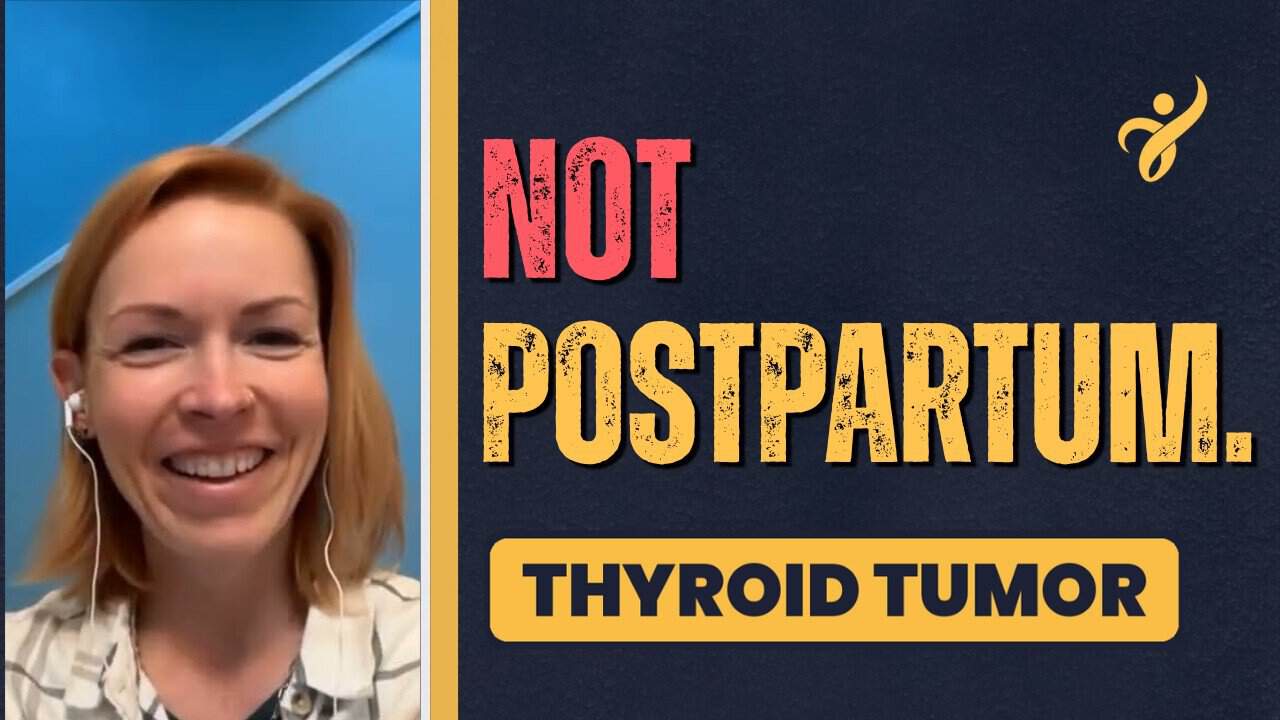
“Just Postpartum”? It Was a Golf Ball-Sized Thyroid Tumor: McKenzie’s Story
▶ Listen on SpotifyAbout This Episode
So many women hear some version of the same sentence: “That’s just postpartum.” For McKenzie Bovard, a military spouse and mom of two who has lived in seven states, that explanation covered up years of crushing fatigue, painful bloating and hair loss. It took a plasma center turning her away three times and one question from her husband to uncover a golf ball-sized thyroid tumor. On this episode of Invisible Strength, McKenzie shares what she learned about trusting her gut, and why her mantra is now “do less to heal more.”
Key Takeaways
- McKenzie’s symptoms (extreme bloating, exhaustion, losing parts of her eyebrows) were attributed to postpartum changes for years.
- A plasma donation center rejected her blood three times, which pushed her to keep looking for answers.
- A year of tests and four-hour round trips ended when her husband asked a doctor a simple question.
- She calls herself the CEO of her own body: the number one advocate for her own care.
- After surgery and a gastroparesis diagnosis, she found she felt best when she treated her illness “like the flu.”
“This can’t be normal”
McKenzie had a two-year-old and a newborn, and the family was living on a small island in Alaska with very little sunshine. There were plenty of reasons she might feel run down. But what she felt went well beyond tired. “I felt pregnant again,” she said. The bloating came with “excruciating pain,” along with an exhaustion she describes as gravitational. She started losing parts of her eyebrows. “I just don’t get how we could be surviving as a species if this was normal postpartum feeling,” she remembers thinking.
The plasma center that wouldn’t take her blood
Back in the lower 48, McKenzie tried donating plasma to earn a little extra money for the family. Before you donate, the center runs your blood. “They took me in the back room and they’re like, ‘We can’t take your blood,’” she said. At the time she was running marathons and eating a whole-foods diet. It happened three times, and it became one of the clues that something bigger was going on.
Get the Free RESET Guide
A flexible, judgment-free framework for rebuilding life with autoimmune disease — on bad days and good ones.
“Have you touched my wife?”
After a year of tests, McKenzie and her husband sat with a doctor who was drawing a diagram of what he thought was a pituitary issue. Her husband looked up and asked, “But have you touched my wife?” The doctor put on gloves, tilted her neck back and examined it for the first time. That’s when he felt something. It turned out to be a golf ball-sized thyroid tumor.
Becoming the CEO of your own body
Even with a diagnosis, McKenzie’s road wasn’t over. She talks about surgery, a frightening ER visit afterward, food fear and gastroparesis. Looking back, she says the biggest shift was internal. “You just realize you have to be your own CEO of your body. You have to be the number one advocate for yourself,” she said. “But it takes a lot of bad moments to realize that’s what you have to do.”
Her advice is direct: if you feel in your soul that something isn’t normal, keep looking. “If that doctor pushes you aside and gaslights you, go find another doctor.”
Treating chronic illness like the flu
After trying every wellness trend she could find, McKenzie noticed that her best days came after she’d rested. “I basically started treating my chronic illness like the flu,” she said. That meant gentle walks and stretching instead of intense workouts, and simple, easy-to-digest food. “How would you treat your child if your child told you they didn’t feel well? You wouldn’t ask them to go do a 45-minute HIIT workout.” That’s where her mantra comes from: do less to heal more.
Follow McKenzie at @thrivekenzie.
Notable Quotes
Episode Chapters
- 00:00 — Welcome and intro
- 00:57 — Meet McKenzie: military spouse, mom, seven states
- 03:00 — Is positivity born or built?
- 05:47 — Early symptoms: Alaska, postpartum and “this can’t be normal”
- 09:47 — Fatigue that lives in your bones
- 11:05 — The plasma center that wouldn’t take her blood
- 13:52 — A year of tests and four-hour round trips
- 15:25 — “Have you touched my wife?”
- 17:45 — Living with uncertainty before answers
- 20:00 — Surgery and the aftermath
- 23:27 — The ER visit that changed everything
- 26:58 — Becoming the CEO of your own body
- 28:25 — Finally, validation
- 32:15 — Trying every wellness trend
- 33:47 — Treating chronic illness like the flu
- 35:45 — Food fear and gastroparesis
- 37:12 — Packing to prevent a flare
- 39:44 — Slow down now, or your body will make you
- 41:28 — McKenzie’s final advice
- 43:38 — Where to find McKenzie
Free resource: Grab the free RESET Guide mentioned in this episode: https://invigorateyourjourney.com/reset-workbook/
Never Miss a Story
Subscribe to Invisible Strength on YouTube and join our email list for new episodes, free resources and support.
Join Our Email List →Frequently Asked Questions
Can thyroid tumor symptoms be mistaken for postpartum changes?
For McKenzie, they were. Extreme bloating, exhaustion and losing parts of her eyebrows were attributed to postpartum changes for years before a golf ball-sized thyroid tumor was found.
What helped McKenzie get a diagnosis?
A plasma donation center rejected her blood three times, which pushed her to keep looking. After a year of tests and four-hour round trips, her husband asked a doctor a simple question that led to answers.
What does it mean to be the CEO of your own body?
McKenzie’s phrase for being the number one advocate for your own care: tracking symptoms, asking questions and pushing for answers when something feels wrong.
McKenzie’s experiences are personal and this FAQ is general information, not medical advice. Talk with your healthcare team about your own care.
Read the full transcript
This transcript was generated from the episode’s captions and lightly edited for readability (filler words removed, names and condition terms corrected). Paragraph breaks mark a change of speaker. It may contain minor errors.
[0:00] Hey, welcome to the Invisible Strength Podcast. I’m excited to introduce today’s guest, McKenzie. She has navigated some crazy challenges with her autoimmune conditions, including a record-breaking thyroid tumor, losing 40 lbs because she was scared to eat. But she has since turned those challenges into positivity and sharing her story online as she helps women start to truly listen to their bodies rather than fighting them. She also lives by the mantra do less to heal more which it goes against our natural instinct to take a step back and slow down.
It can be really hard to do at times but it’s often very necessary in our healing journey. I’m excited to have her share her experiences and insights. And Kenzie, thank you for joining us.
[0:52] Thank you so much for having me. I’m excited to be a part of it. Never done anything like this before. So, it’s exciting.
[0:59] There’s so much more to you than just your autoimmune condition. Can you tell us a little bit about yourself?
[1:05] Yeah, absolutely. I am 40 years old. I am a military spouse who has two little boys and we have lived in seven different states. I was born and raised in Washington State, graduate at Washington State University and I’ve loved the Pacific Northwest my whole life and we just moved back here from being relocated all over the place. So I boy I’m a part-time real estate photographer and that means that I kind of like spend most of my time looking for light and bright things throughout my day. And I feel like in the area that we currently are, I am able to do that really well.
The Pacific Northwest, right on the Pacific Ocean, is just absolutely gorgeous. In doing that, have learned to find in dark holes or dark despair, find light and bright moments.
[1:57] So, I love cooking. We have a long-haired French bulldog who is like this spunky little ray of sunshine that runs around our house. And all of our family lives in this area. And it’s the first time in our military career that we’re close to our village, which has been wonderful for reigniting family ties. We’ve been transient and we’ve been relocating for so long that this is the first time where we’re going to have the opportunity to kind of like dig roots and kind of do what we want to do. And we don’t know what that looks like.
So, it’s kind of an interesting feeling like when people are like, “Oh, what is it going to feel like to live in the same house for 5 years?” I’m like, “I don’t know. I’ve not done that for almost 20 years. So to be able to like put my Christmas tree up in the same spot every year without having to move is going to feel really odd, but we’re very excited about it and we love this area. So it’s amazing. You’re entering a new chapter. That’s really exciting.
[2:52] Yeah.-huh. I know, right? And we feel so young to say we’re retired, but it is what it is.
[2:58] Good for you. That’s awesome. McKenzie, you’ve recently started sharing your story online with your autoimmune conditions and your handle is it’s thrive with McKenzie, right? Thrive Kinsey. Yep. Have you always been positive or have you had to cultivate that along the way?
[3:19] Boy, that’s a good question. Yes and no. I’ve always been a positive person. Like that’s just been my spirit to my core since I was younger. it was always kind of like that pushth through bubbly personality. So yeah, I would say it was always positive. To put words to it, I think have been more recent. because I think it was more like of a silent struggle and I decided to start vocalizing it to help myself nail down the actual healing part because it’s like when you create a goal, right? Most of the time they become more successful when you’ve written them down or said them out loud.
And I feel like that’s what I was doing. And I was just kind of like, okay, I’ve been navigating this and trying to heal from this. You know, like my surgery was 4 years ago, but I obviously had, you know, issues prior to the removal of the tumor. So, it’s been really like an 8 to 10 year journey. And I’m just like I felt like it needed to kind of have a name and a title so that we could go forward. And there’s definitely been some dips of not positive moments.
[4:22] But I feel like because of those when I come out on the other side, my positiveness is a lot more vibrant because I realize where I came from or I can learn from it. And also, I feel like the farther I am in this journey, the larger my village becomes in terms of other women who are experiencing it. So, at the beginning, it kind of felt more lonely and I didn’t know that other people were dealing with it. And the more I vocalize about it or the longer I’ve been dealing with it, the more like other people that have had the same issues come out of the woodwork.
So, it’s easier to feel more positive when you have a net of other women who are like, I too have to take six snacks a day and I too am really bloated, so I don’t want to wear pants by the time it’s bedtime and all that kind of stuff.
[5:03] So, so yes and no. I’ve been very positive, more positive than I think most would be in my situation. Well, and I think you bring up a good point. There’s something to be said when you go through such dark challenging times that you know how tough it can be when you are on the other side of it. It can be easier for some to have that positive light because you just know how bad it can be. Even the little dayto-day things can feel meaningful and joyful.
[5:35] Yeah. 100%. You really stop taking for granted the 6 hours of feeling normal. Woo. That’s a win.
[5:45] Is 100%. Waking up without a swollen face.
[5:50] Can you take us back to the beginning and walk us through what were some of those small things that you started to notice before you realized something was really wrong? Well, so we were stationed in Alaska and it was right after I had my second baby. And obviously I had a 2-year-old and a newborn and we were living on a tiny little island in Alaska that really didn’t have sunshine. Like so there were a lot of factors that could have contributed to why I was not feeling well, but I just like I was having extreme bloating.
Obviously post delivery you have symptomatic issues like postpartum blah blas, but I was like I felt pregnant again. Like my belly button was flat. I swear I would like eat air and it wouldn’t just be like bloating, but it’d be like excruciating pain and then it would be coupled with like just gravitationally pulling exhaustion. And I started losing parts of my eyebrows and my eyelashes. And my baby is a fall baby, so we were obviously going straight into winter. and again, since we’re in Alaska, you don’t see a lot of sun.
So, there’s a lot of health issues that kind of like spawn up for people that haven’t been native to Alaska without seeing sunshine or vitamin D or eating all these fresh vegetables that you typically get. So, I was going to the doctor and I was like, I know I just had this baby and I know I have a toddler at home. I know it’s dark. I had a child before that there are symptoms of giving birth and having babies, but I just feel deep to my core that if these were the symptoms of having babies that women were supposed to be feeling, we would stop having children.
I’m like, I don’t know why you’re giving me my driver’s license back. Like, I am We lived on a 14-mi road island. And I could barely make it to the hospital like driving and it was like maybe a 5-minute drive, but I’d be like so tired. But the car hadn’t even heated up. I’m like, I just don’t get how we could be surviving as a species if this was normal postpartum feeling because I kept going to the hospital. My stomach would hurt. I started like researching like, am I allergic to quinoa? There was a woman that told me that maybe I was allergic to an enzyme and chicken.
So, like I was just like, okay, maybe it’s my food then. Like, I’m all of a sudden developed these allergies to things or, you know, I’m losing my eyebrow hairs from the stress of the two kids. I’m nursing. So really those were the three things I had extreme fatigue, loss of facial hair. My normal hair was pretty postpartum typical where you’re losing it while you’re nursing. Every time I’d go to the doctor, they would just say like, “This is normal. You’re postpartum baby.
You have a newborn and a toddler and we’re going into winter and you’re living in Alaska.” These are just part of the mommyism issues that everyone goes through. And honestly, when I would talk to all my friends and I would explain to them that I’m tired or that my stomach hurt or like the hair loss, they were all able to bring stories to my attention that had happened to them that made me feel like this isn’t abnormal, I guess, but I was not being very specific in the severity of what I was feeling. So, when I’d say I was tired, they’d be like, “Oh, me too.” Cuz they too also had children.
I think the difference was is that my struggle was more like you feel like you can’t get out of bed at all, right? Or when I’d say hair loss, they’re like, “Yeah, I’m losing hair.” But it felt like I’m losing my eyebrows and I have no eyelashes and I’m not having any hair up there. I’d say I’m bloated. Like I can’t wear pants. Like I look 6 months pregnant again. So obviously those are the details you kind of leave out when you’re having small conversations with other moms.
But when the doctors were saying I was fine and other friends were giving me tidbits of their own experiences, everyone’s like, “Oh yeah, I feel that too.” Like, “Okay, well shooks.” But or I knew that there was something wrong. It was like that psychological battle of everyone was saying that it was normal, but I was like, “This can’t be. There’s no way.
[9:33] There’s got to be something wrong here cuz it was mentally torturing and it was really hard.” Especially being on an island. We didn’t have choices. We had a hospital, a gas station. It wasn’t like I could be like, “Oh, I’m going to go see a specialist.” I would have had to flown off the island for any of that. So, you know, it’s the time of the moment, but
[9:51] Yeah, when we talk about fatigue and exhaustion, it is such a heavy weight that’s hard to describe to other people. It’s common response for people be like, “Yeah, I’m tired, too.” And you don’t want to be the person that’s like, “No, you really don’t understand how tired I am.” No, I know. I’ve tried a couple times to I have a very supportive husband and very supportive family now cuz I’ve reamed in my invisible illness into their heads.
But when I try to describe it, I’m like it’s like your bones are full of metal and you can almost feel like the world is rotating because you can’t like those fair rides where they like spin you super duper fast and you’re like smashed up against the wall. That’s what it feels like. You have to get on the ground. Your bones feel so heavy and you feel like you’ve been hit with something. It’s not just like I could go take a nap for a little bit. It’s like I am so exhausted.
[10:44] I don’t know if sleep’s going to fix it. That’s a feeling that you have. And that’s a really hard one to explain to somebody that’s like, well, just take a nap and you’ll feel better. It’s not so deep.
[10:54] Yeah, I appreciate you saying that it’s in your bones. It is so heavy that a nap, even four naps, isn’t going to fix it.
[11:04] No, I wish. I’ve tried. With you being on an island with one hospital, how did you start to get answers? Well, it wasn’t in Alaska. The CO outbreak happened and we literally were relocated off the island like 3 months after it. So, we were moved to Mobile, Alabama, and it wasn’t until I moved down there that we really accidentally came across it. There was a whole bunch of quarantining in between. There was a lot of stress, as you can imagine. They moved us quite far considering the world was shut down.
We were very lucky to get off the island, but once we got there, things were really minimal. We had an Airbnb and it took like 60 days for our household goods to get there. So, we were really just trapped in a town we didn’t know anybody or anything about.
[11:49] So when we finally moved to our house, I put the kids in daycare just so I could have a small break. Was 2 days a week cuz they were two and four, so they were little. And I was ready to cuz we hadn’t been in the lower 48 for 4 years cuz we were on this tiny little bush island in Alaska. So, I was like, I know that everything’s shut down, but I want to get out and start doing things. So, down in the south, they have plasma donation centers where you can go and you can donate your blood and they give you like 80 per visit.
And I was like, “Oh, this would be a great opportunity for me while my kids are out. I can get money and then we can use it as date money or play money and I can start contributing cuz in Alaska, my husband was the bread winner and I was ready to pay for a needle out.” So, I went into one of the facilities and before they allow you to donate plasma, they draw your blood and run it through to make sure that your blood is okay. And they drew my blood and they did the whole thing and they took me in the back room and they’re like, “We can’t take your blood.” And I was like, “What?
I’m feeling pretty healthy, right? I have a two and four-year-old. At the time, I’m running marathons. I have a very whole foods diet. Besides my fatigue and postpartum issues that I thought I had, I was like, “My blood should be gold to you, especially since I’m looking in the lobby here. You got homeless Joe donating his blood or someone that doesn’t look like they’re taking care of. It’s not a prestigious location, but they were like, “So, your protein levels look really high. You’re probably just fighting off some cold that you don’t know that you have. Come back in 3 weeks.
We’ll redraw your blood.” So, I’m just thinking maybe you’ve got a little bit of a cold. We’ve traveled a lot. You get bugs and stuff like that. That’s so I came back 3 weeks later, same thing.
[13:23] They brought me in the back and they’re like, “McKenzie, we can’t take your blood. Your proteins are still too high. Come back again. I am very resilient.” I went back one more time and they brought me to the back and they’re like, “Unfortunately, we have to put you on the cannot donate list. Your protein levels are too high. You just can’t keep coming in. It’s a no for us.” So, I went home and I didn’t really think much about it. I was just like, “Wow, what a stickler of a place this is.” Cuz you don’t think that you have something. I immediately go dark.
I was like, “Gosh, this place really needs pure blood.” So, I told my husband and he’s like, “Oh my gosh, seriously, we need to you need to go to the doctor.” So, I went to our family practitioner and she drew my blood and said the same thing. and she was like, “I think it’s your hormones.” So, she’s like, “I can’t really tell what’s happening, but let’s send you to an endocrinologist.” Being military, they kind of row for you, especially with a specialist. They put you within a certain radius of things.
[14:13] So I had to drive almost 2 hours to Mississippi to an Air Force base where they had an endocrinologist. So I drove there and they did not find the tumor immediately. They spent almost a year doing other tests. so they did cortisol tests, adrenal tests. They found a nodule in my pituitary. So they went that direction. Maybe I’m going to need brain surgery. So almost three to five times a week I was driving two hours to Mississippi.
I’d drop the kids off or I’d figure out a schedule around my husband’s schedule and I’d drive the two hours there, go through some silly test or blood draw or conversation with my endocrinologist that really never seemed to go anywhere cuz it was all the same stuff of well maybe it’s just babies, maybe it’s the stress you did just move down here or it’s the pituitary. Well, it’s not the pituitary or maybe you’re menopausal, you’re not menopausal cuz I still hadn’t had a period since my youngest baby. So, at this point now, we’re 2 years into no period.
They were kind of just hoping that maybe it was menopause or something. To be honest, they really don’t know. They just kept throwing spaghetti at a wall, hoping something would stick, but it was taking a lot of time cuz it was a 4-hour round trip. It really wasn’t until Alabama or Mississippi, let’s be specific. but there was one moment where my husband was just kind of getting fed up and he’s like, “I’m just going to go with you.” And we saw my endocrinologist, who I’ve known really well at this point, right?
[15:35] And my husband’s sitting there and the doctor is literally drawing a diagram on a piece of paper for my husband to see how he thinks that’s my pituitary’s issue and like how it’s like all connecting and blah blah blah. My husband just doesn’t really skip a beat and looks up at him and goes, “But have you touched my wife?” And the doctor like looked at him and oh, it’s, you know, co we’re not really, you know, doing that.
He’s like, “No, but of all the symptoms she’s complaining about, have you actually physically given her an exam?” And he stood up, put gloves on, and he tilted my neck back and he touched my neck for the first time. And he was like, “Oh my gosh.” I was like, “What?” And he’s like, “Well, nothing. I just feel something that seems a little larger than normal.” And that was the beginning of it. I kid you not. Within a month, I was in surgery. He streamlined it extremely fast. So, he obviously felt something very large on my left thyroid.
[16:28] It was a golf ball-sized tumor that had grown behind it. So it wasn’t in the front part and attached itself to my spine. So they did an ultrasound and thyroid. They’re really teeny. And the other one was just huge. So then they gave me the biopsy and it was non-cancerous. So I was very fortunate in that. but because of its size and who knows how long I’ve had it at this point, it had done quite a lot of damage. So I had it removed then like a month later. It was a long journey. I didn’t get answers in Alaska.
And to be honest, I don’t know if the journey would have been as long had it not been in the middle of CO. I’m not saying that the doctors weren’t doing full things, but it was different protocols then for something that symptomatically did sound like I was just kind of sick. They were obviously dealing with a lot of sick patients coming in.
It was co so you know everything was gloved and people weren’t really touching each other and everything was like six feet back and all the masks and it really took my husband to come in and be like, “Have you touched her?” for them to really be like, “Not really.” And I didn’t think of that either, but
[17:32] It’s still kind of mindblowing that it took that to get them to actually examine you.
[17:40] I know it’s mindbgggling like what is going on here? Then it makes you second guess yourself.
[17:46] Yeah. I’m curious cuz it was years and there was so much uncertainty during that time. You’re thinking, “Okay, something’s wrong. We can’t figure this out. How did you deal with the uncertainty before getting answers?
[18:01] I don’t I, you know, to be honest, I think it was a lot of false thinking. I’ve never been one to turn to negativity quickly without there really being a rational reason. I mean, obviously I have moments, but I really try to not stress about things until I know it’s happening. And I was a very busy person. And a lot of the moments where I felt my worst, my environment didn’t really give me the space to have a breakdown. I was having babies. We were living on an island. Co hit. They moved us to Alabama. Our life started over there.
Maybe if things would have had a routine or I had the opportunity to really see change in myself that wasn’t what I thought was environmental, I maybe would have dealt with it differently. But know when you’re being thrown all over the place, it’s hard to feel your insides or emotions cuz you’re really distracted. There’s no time to feel sick when you have a 2-year-old and you’re breastfeeding and then they move you down to a new state on the other side of the world.
So, I think it was forced positivity because being a military family, you are put in situations and you are forced to do a lot of things that you don’t want to do.
[19:12] And one of the things I would imagine most military spouses could agree with is that the only way to get through some of the changes and choices that you’re forced to be a part of is to be as positive as you can. Otherwise, nobody would survive. It was just forced habit. I just was like, well, until we know, we’re not going to stress about it. I just kept thinking, maybe they’re right. I know I was getting gas lit, but maybe they’re right. It is stress that I don’t have my period. It is postpartum depression or it is postpartum hair loss.
why this is happening or maybe I all a sudden have all these allergies. I’m feeling bloated. I didn’t have the time to overthink it. So, I didn’t really question my happiness outside of the diagnosis.
[19:53] Yeah. When we’re that busy, there’s no space to be sick. So, you don’t and keep going forward.
[19:59] Yeah. Yep. Just push through very much so. So, what did your healing journey look like after you had surgery? And at this point, did you know you had an autoimmune condition or was it just the not just because I mean the tumor is obviously a very serious scary thing, but was that isolated or were you starting to figure out your autoimmune situation?
[20:23] All of that came postsurgery. And to say that I had it pre-surgery is hard to say. It’s all chicken versus the egg. As we know with a chronic illness, the more they poke and prod at you, the more they find. But it’s like did you have it before or was it something that they’ve just found? Right? Which one came first? I would in my best educational guess say that I had a lot of these issues before and then they think they got exacerbated postsurgery. 100% of my diagnosises came after my surgery. But it wasn’t until about a year after my surgery. So they took my left thyroid out.
My surgery did not go well. I’m very susceptible or not susceptible to anesthesia. Little did we know cuz I’d never been put under before. So, the surgery was supposed to be like 4 hours. We were on Mississippi.
[21:11] So, my husband and my two little baby boys are in the waiting room. And they’re like, “She’s going to be out at 1:00.” 400 p.m. happens. Nobody told my husband what’s going on. And he’s like, “What is happening?” And the nurse is like, “Hey, look, you should probably go get dinner. Your wife’s fine. but she’s not finished yet.” And turned out I was not put to sleep properly. So, I woke up in the middle of my surgery. It pulled the breathing tube out of my mouth and then I ripped my stitches open. So, then they had to resedate me and they had to do everything again.
Unfortunately, because of that, the double being put to whatever dose of anesthesia. Part of my organs chose not to wake back up and so I have gastropar paralysis now. I don’t know if that was like a symptom of the tumor or more of the just being knocked out multiple times in one senting. And so after my traumatic surgery, which was unexpected, but I handled it, they handled it well, considering anybody would be scared to have a woman wake up halfway through their surgery and pull out the breathing tube. I’m resilient. So they sent me home and they didn’t give me like level thoroxin.
They gave me no synthetic hormones. It literally pushed me out of the wheelchair. I’m still actively ill and my husband’s like, “Are you sure you shouldn’t be keeping her overnight?” and they’re like, “No, no, no. I’m still completely out of it being driven home.” but like 3 months later during checkups and stuff, I’m like, “I just don’t feel well still. I almost feel worse.” Like, did you do this right? You had basically told me that you’re going to take the tumor out and then my right thyroid is going to start picking up, right?
They said that after they had taken my left thyroid out cuz it had been completely consumed by the tumor.
[22:47] So, there was this ginormous pocket in my neck that they had to fill with coil like tubes and stuff. And they’re like, “Your right thyroid should then kick up and take over the thyroid that we just took out.” And I’m like, “Okay.” But again, 3 months after, I don’t feel better. I feel worse. Again, I’ve never had surgery before. I’m still healing. I’m expecting there to be a moment before I can actually feel the positive effects of this. But jeez, it was really intense. I was still excessively bloated. And they kept saying, “Well, that’s just because we had to give you so much anesthesia.
Some people just don’t react to it.” Well, I’m like, “Okay.” And had gone and dropped both my boys off at daycare. My husband’s at work. I’m not one to raise a white flag quickly. All Gran and Barrett. It’s not a positive part about me, but I’ll push through most of anything. I dropped the kids off at daycare and we lived like a mile away. I get home. I get out of the car and I get to the kitchen and I have to get on the ground. I feel like not that I’m going to pass out, but something felt so wrong that I had to get on the floor.
I was having a hard time breathing, but I didn’t feel uncomfortable. Like, it just something was happening where I was like, I don’t feel right. So, I called my husband and I was like, “You have to come home. I’m on the floor in the kitchen right now, and I don’t know what’s wrong, but I don’t feel right. You just have to come home.” The unfortunate part is being military, we’d not live there long enough. We don’t have a village. We know nobody else. I had nobody else to call.
[24:09] Calling my parents who lived in the Pacific Northwest like, “Hey, could you get on the plane?” So, we go to the emergency room. My heart rate was at 34 beats per minute. So, the doctor was like, because I didn’t have a working thyroid, my hormone levels had dropped so low that my heart rate was just slowing down cuz I didn’t know, but your hormone level is directly related to your heart. So, you don’t have a lot of hormones or you have none. Your body runs off of that stuff. So that was when they found out that my right thyroid had died or stopped working or whatever word you want to use.
[24:41] Yes. The doctor was like, “Had I had chosen to go to sleep, if I would have been on the floor and been like, I’m just going to take a nap,” he’s like, “You probably wouldn’t have woken up.”
[24:49] So yeah,
[24:50] Goodness.
[24:51] I know. Well, I mean, 34 beats per minute is pretty
[24:54] Yeah.
[24:55] Not there. So
[24:57] That was when they started putting me on level immediately. We started on a pretty low dose and symptoms came from that. like I was having hormones and things, but that was the low moment. That was the moment where I was like, surgeons are really good at cutting things out of your body, but they’re not really good at explaining what to do now that this organ has been removed. I don’t think I had educated myself or been educated enough on the system that they were changing. I didn’t know that my thyroid or my hormones were so important to the functionality of my whole body.
the fact that my heart rate was down that low. I was like, “What? Why?” “Well, cuz your endocrinatic system is not working right.” Like, how do I not know this? How do I not know something that you just did to me would have such side effects? I should have been paying attention to that, right?
[25:48] Why was I sent home without a thyroid? You didn’t say, “These are some things you should be watching for besides just feeling not well. That could be something like let’s go to the hospital, get this checked out.” It was a lack of education and a lack of knowledge that really brought me to a spot where I was like, “Oh my gosh, what has happened to me was a lot more serious than what I thought. We didn’t have family come down. This was just supposed to be a simple thing.” Little did I know that I was going to be navigating almost dying multiple times from the large tumor, but so small, right?
It just wasn’t said to me. And maybe that was not to scare me, but after that scare, they did have to put me on a lot of anti-anxiety meds.
[26:27] Because I started having panic attacks because I was like
[26:31] So nervous afterwards of dying. This big whoosh of the severity of what I had happen to me hit really hard and I was like, “Oh my gosh, I wasn’t prepared for that.” So, they just gave me drugs and sent me home. They’re like, “Here you go. This will help you deal with it. here’s your synthetic hormones and here’s some anti-anxiety meds and it’ll be all good. That’s all it was. I spent the rest of the time googling and trying not to freak out about it. Yeah. I can’t help think about the number of times that you were gas lit and then also considering the lack of education.
I’ve personally experienced that too. Why didn’t you tell me this could have been a side effect? The one brochure you gave me didn’t have that information.
[27:15] Totally. I know. Oh, well, the unfortunate part about being looked at as frequently as you are, you start to feel crazy. Your family gets tired of hearing the same things over and over again. Your doctor gets tired of hearing the same things over and over again, but you feel in your gut. You’re like, I know I’m repeating over and over the same silly symptoms. I shouldn’t be concerned about my eyebrows. It sounds so egotistical, right? Or the how tired I am when I’m so fortunate to have the kids. all of these things, but you just realize you have to be your own CEO of your body.
You have to be the number one advocate for yourself. But it takes a lot of bad moments to realize that’s what you have to do. I don’t think year one of this illness would I have been so aggressive. But if I could go back to that person before, I’d been like, “This is what I need you to do.” And that’s sad. I was being gaslit so aggressively, but I didn’t know. It’s unfortunate that now we have to go in and know more and explain more to get what we need to get a result that doesn’t make us feel crazy.
One of the most bizarre parts of my journey was when they found out that I had a record-breaking size tumor. You would think that most people would go home and cry out of like, “Oh my gosh, I have a tumor.” I cried because I needed that to validate that I’m not crazy. It was a huge thing. I didn’t expect to get emotional.
[28:50] It’s hard talking about this stuff. You’re making me teary eyed. It happens. But it was breathtaking. Like frick. Now all those moments where you’re like arguing with your mom or you’re trying to play with your children and feel so guilty that you can’t do it. You’re like, “It’s not that mommy doesn’t want to be there or that your wife doesn’t want to be there or that your daughter can’t do it.” I was like, “What? I have a tumor, guys.” Like, there’s a piece in my body that will actually show you that my invisible illness is legit.
And that’s so bizarre to have that type of validation, but it’s where you are. I appreciate you being so honest and open about it because it’s a very real struggle that many of us go through. We
[29:39] Have that self-doubt before we have those answers. And when you have doctors saying, “No, you’re fine. You’re fine.” And then you finally have the proof to be like, “See, I’m not fine.” It’s weird, but there can be such a huge sense of relief that I’m not crazy. There is something seriously wrong here. It’s sad that’s what we have to have, but I do feel even the title of this podcast, invisible strength, that’s really what it is. It’s so invisible, but to the person that’s dealing with it, it is the ball in chain that follows you every day.
And I feel that if somebody lived through just a normal day on a day where maybe we’re not having a flare up or you’re at a 75% some people would go to the hospital.
[30:29] Yeah.
[30:29] And yet we just do it on a normal basis. It’s a hard thing to explain cuz it seems so exaggerative, right? I have the most supportive husband and the most supportive family. But sometimes I won’t express a thing or like with gastropalysis, I don’t have an intestine that really works all the time. So my bowel movements are like every 10 days sometimes. When I say that out loud, to me it seems normal, but like in a group setting of people who have a normal working system, they’re like, “Oh my gosh, I would be in the hospital after like day three.” I’m like, “Really?
I couldn’t do that because I’d be living in the hospital. Like, you’re right. That makes sense. It is what it is. But out of everything, it’s learning to be your own CEO. You have to be the biggest advocate for yourself. You have to push through what feels crazy. If you in your soul feel that there is something wrong that’s not normal, that should be fixed. You need to go find a doctor and you need to really express it. And if that doctor pushes you aside and gaslights you, go find another doctor. Go find a naturopath.
Go find somebody else that will take you seriously enough to start the process of searching for what could be your ailment because the person that knows you most is you. And that’s all it is. Doctors know what they’re doing, but you do have to show them where they need to go.
[31:51] Well, and it’s having that trust in yourself that you do know your body more than anyone else does. So, being that self advocate is essential. We’ve talked about at times you can secondguess yourself, but you bring up helpful advice in that start tracking your symptoms. Start really noticing what’s going on with you so it’s easier to articulate to specialists and your support network around you. So how you have cultivated that self-rust, that self-compassion throughout your journey, especially after being gaslit so many times.
Well, I spent a lot of time because I wasn’t educated on researching and trying to find how to make myself feel better. Like, okay, I was a marathon runner. Do I need to be working out differently? So, I started lifting weights instead of running or I was vegan for a while. Like, maybe I need to change my diet up to make myself feel better or maybe I need to adjust my sleep schedule. I just knew that I could only control one thing and that’s how I dealt with my own body. My body was going to break down. I couldn’t control that part of organs shutting down or tumors growing.
then I could control my external environment. So, I started researching on the best ways that I could control them that would be advantageous to my illness. And everything I found online and everything that I talked to people with, I would try and it would make me feel worse.
[33:16] None of it worked for me. And I was like, I don’t get it. I’ve adjusted so much of what I’m doing. And yes, there’d be like little moments where I would feel better or I started doing the intermittent fasting and I felt good for like a little bit and then it would be the complete opposite where I would feel super bad. I just was like, I don’t get why I’m trying all these wellness trends. I’m taking all of society’s opinions and doctor’s guidelines and I’m giving it 100%. But I’m not feeling good enough to where I’m like this is making a change that’s positive.
So after multiple repetitions of not feeling better, I realized that on the days I felt my best were the days after I had given myself rest, where I had treated my illness like actually being sick. And it was kind of defeating to be like, “Oh my gosh, I basically started treating my chronic illness like the flu. I was giving myself rest. I wasn’t pushing myself at the gym. I was just maybe doing stretches and gentle walks.
[34:21] I was eating extremely basic, easy to digest food and I was feeling better and I was like, is this it? Is this the secret? Is doing less what’s going to heal me? And that’s what I’ve been doing basically since. I stopped following the normal societal pushes and I started treating my illness like an illness, like the flu. How would you treat your child if your child told you they didn’t feel well? You wouldn’t ask them to go do a 45minute hit workout. You would you wouldn’t have them have a high protein diet and ask them to fast for 24 hours. You’d have them rest.
Maybe go outside and get some sunlight, get some fresh air. You’d have them eat something that’s nourishing but not chemically based. You wouldn’t give them McDonald’s. He would give them something that would heal them from the inside out. And that’s what I started doing for myself. And I’m not perfect at it. I’ve been doing it long enough to say that’s the magic trick. But I can tell you that having been doing it for more than a year, I can consistently control how I feel.
If I control my body and do less, if I know I’m sleeping well and I know that I’m eating good and I’m just taking it slow. And really, that’s all it is.
[35:44] I’m doing less and I’m healing more. I feel much better than I did before. We hadn’t talked about it, but there was a definitely a moment where food was a big problem for me postsurgery after they diagnosed me with gastroparesis paralysis because everything I ate, my body just couldn’t handle. So, I was like really all over the board with trying to figure out what I had to what I could eat to make sure that I was like going through and not feeling bloated. And there was definitely a long time where I just stopped eating because I was so afraid to put anything in my body.
And like touching back on what would you do if your child was sick? I wasn’t treating myself well. I didn’t feel good. So, I was like, well, I’m just not going to eat. But would you let your kid do that?
[36:27] I was not feeling well. But then because I wasn’t eating cuz I was so concerned of like going to the hospital because it was just sitting in my abdomen, I wasn’t treating myself well. Then that would put myself into stress and then I would overcorrect it by exercising. It was just repetitiveness really. I had a light bulb moment where I was like, “Huh, it’s obviously not that complicated, but I was making it complicated.” So, I put the pieces together and started realizing that post the days that I had actually given myself grace, I felt better. I was like, well, I did that yesterday.
Maybe we do it two days in a row. Maybe we do it three days in a row. And consecutively, I can almost now at this point tell you when I’ll have a flare up according to the day that I had yesterday.
[37:13] Wow.
[37:14] So, I really protect stuff. Like we went and had a weekend in Portland and I brought all of my things, everything that I knew, my fuzzy socks, my magnesium, my little sleep sound machine, food, my own salt, things that I know are going to make sure that my body doesn’t feel stressed and doesn’t stress me out so that I can make sure that I don’t have a flare up. It’s not perfect, but it’s a learn curve.
It’s so important especially for us where you had talked about that period of time where you are so crazy busy that there’s not time to be sick and until you have that light bulb moment of maybe I do need to slow down and it’s about finding that new rhythm can’t heal when you’re in that constant fight or flight state. The gear isn’t just to take a nap, but it’s really about finding that new rhythm of okay, what can you do in a day without pushing your bodies to the limit? And it’s absolutely against everything that we’ve known our whole lives since you were little, right? It’s always faster.
Let’s do it. Like, put your shoes on, get your backpack on, you got to go to school, you got to go to sports. And it’s just ingrained. I’m 40 years old. I’ve been doing this for 38 years.
[38:32] Yeah. really if you think about it where I’ve been pushing through and making sure that we’re checking all the boxes and getting all the stuff done. So to say to do less to heal more is the absolute opposite of what anybody does. But if you look at most people that have healed themselves, it’s not because they ran more marathons. Right.
[38:53] Right. It’s not because they started eating more processed food or sleeping less. Most of the time when you hear a story of someone that has healed themselves, they started reconnecting with family. They started doing what we’ve done prior to this go culture and really trying to listen to yourself. And I know that’s hard, especially as a mom who’s trying to raise kids, you kind of stop seeing yourself at all cuz you’re just trying to raise children. It’s a hard one, especially when you feel kind of insane that all of your ailments are fake, right?
[39:27] Yeah. I appreciate you bringing that up because it’s a tough lesson for many of us to learn, but I know my life changed once I was able to find a new rhythm. I can actually live well with this condition. I just have to do it a bit differently.
[39:43] And you have to educate your family and once your family gets used to it, it’s the way that it goes. But if you want to feel good, I feel like there’s a lot of people that have guilt. Well, like that would be inconvenient. That would blah blah. It might be inconvenient, but if you don’t do it now, your body will force you to do it later. And it’s going to be on its own terms, and it might not be as polite as it would be if you did it yourself. So, there’s only so far you can push it before your body will just collapse.
As we all know, it’s very defeating to sit there and grieve the body that I used to have that could do things that I can’t do anymore. But that’s how I survived. I’m not the same person anymore. I can’t run a marathon. I can’t go out in the world and act the same way as I did before. I’m a different person and that’s okay.
[40:29] Yeah, you can thank that previous person because she got you to where you are today, but now it’s about doing what you can and looking forward and looking at it as a new season, a new chapter. It’s okay to be sad that you can’t do some of this stuff that you did before, but it just looks different now.
[40:47] It does. Yep. It’s really how most people just age.
[40:51] Yeah. It’s not anything unique to somebody that specifically has a chronic illness. it’s just a little bit more exacerbated. It’s a little bit more detrimental, but a 70-year-old, right? A 70-year-old couldn’t say that the same thing when they were 20. And that’s just the way that it goes. You have to treat your body with gentleness. And once you figure out what’s going on, who cares what everybody else thinks? Nobody cared when I felt horrible. They didn’t believe me then. So, what does it make any difference now if I say that my own table saw is making me feel better? It’s not their problem.
It’s mine. And if I know I can make myself feel good by doing less, then that’s a golden ticket, man.
[41:28] Yeah. More power to you.
[41:29] Yeah. McKenzie, is there anything else that we haven’t talked about that you think is important to share with people? Going on with the slogan that I’m trying to push is doing less to heal more and learning how to thrive, not just to survive. Really realizing that you need to make sure that you are listening to yourself. you’re being your own advocate, that you’re not feeling guilty for the things that you know deep down your body needs to feel well. Because if you don’t do what you feel like your body needs to have done, your body will eventually force you to do it.
It’s really hard because I think the world loves to praise women on making sure that they’re grinding and showing up and doing all of these things and doing less is so the opposite of what we’re taught.
[42:20] But really to protect your peace and making sure that you’re showing up with joy and showing up with conviction in your in yourself is really what’s going to push you through and really going to have you see the change that is going to be the best for you. I know it’s difficult and you’re not alone, but we got to listen to ourselves and not feel guilty about it. You got it. And as long as you’re doing what feels right to you for yourself to heal, then that’s really all you can do. Because at the end of the day, you’ve got yourself.
And if yourself isn’t being treated well, it’s going to be a hard one to get through.
[43:05] Sure.
[43:06] Just re readating for protecting yourself and being your own advocate. It can be hard to learn and it can take really tough experiences to actually truly learn those lessons. So, I appreciate you being on the other side of it and sharing your perspective because if I could have learned those lessons earlier in my journey, I would have saved myself years of a lot of pain, unnecessary suffering and challenges. Thank you for sharing all that.
[43:37] Absolutely. Thank you so much for listening. Yeah, we mentioned it, but can you remind people where they can follow you on socials?
[43:46] I’m on Instagram and Tik Tok and Facebook. My handle is ThriveKinzie. and I’m just here to help women protect themselves and feel better by doing less. Yeah, I appreciate that. If McKenzie’s story resonated with you, I strongly encourage you to share it with a friend. These conditions can make us feel so isolated and alone and even crazy at times. We want to be able to support each other through these shared stories. And if you’re looking for extra support, please visit invigorateyoujourney.com.
We have coaching, all sorts of free guides, and other resources to help you through wherever you’re at on your journey. Thanks for being here, McKenzie. It was nice getting to know you today.
[44:30] Yeah, it was wonderful.
[44:31] We will see you next Wednesday on the Invisible Strength Podcast. Take care. Peace.
Medical disclaimer: This post is for education and shared experiences only and is not medical advice. McKenzie’s story is her personal experience. Always consult your healthcare team before making changes.

